


- Home
- Companies
- Membracon Process Separations b.v.
- Products
- Forward Osmosis (FO) for Natural ...
Forward Osmosis (FO) for Natural Membrane Process System
Forward Osmosis (FO) is one of the known procedures for all types of water treatment, due to its benefits Forward Osmosis is used within many industries for the reuse and recovery of water. Here we will explore this process in more depth.
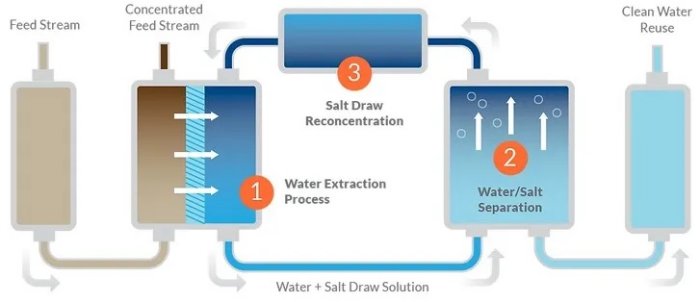
Forward Osmosis (FO) is a natural membrane process found in nature capable of extracting pure water from impure sources. Unlike Reverse Osmosis (RO), which uses hydraulic pressure to drive water across a semi-permeable membrane, FO uses a “draw” solution to draw water across it. FO spontaneously draws water across a membrane whenever one solution is higher in salt concentration or solute (draw solution) than another (feed solution). The difference in salt concentration between solutions is known as the osmotic gradient (Δπ) and is the free and natural energy responsible in powering the water extraction process.
As water is drawn from the feed solution into the draw solution across the semi-permeable membrane, two things occur; the feed becomes concentrated, and the draw solution becomes diluted. The result of this is a reduction in the osmotic gradient between solutions and in turn a reduction in the flow rate across the semi-permeable membrane known as flux rate. For forward osmosis to operate continuously, water drawn across the membrane into the draw solution must be removed continuously so that a maximum draw concentration can be maintained and a maximum concentration gradient achieved.
1. Water Extraction Process
Water is drawn across an FO membrane into a salt draw solution. The combination of a patented draw solution and a unique FO membrane, effectively "locks" the draw solution on one side of the membrane, making it the first true closed loop process
2. Water/Salt Separation
The process of water/salt separation is accomplished using a patented "Switchable Water Salt" (SWS) and the use of low-grade heat (60-85°C). When low-grade heat is applied to the SWS, it phases from a liquid to a gas. As gas leaves solution, clean water is left behind. The thermal energy needed to drive this process can be from waste heat, solar thermal, geothermal or other sources.
3. Salt Draw Reconcentration
As gas leaves solution it is captured within the system and passively cooled between 10-15°C causing it to phase back into liquid and to its original SWS concentrated form. The SWS concentrate is collected and recycled back to the FO draw inlet in Step 1, establishing a closed-loop, continuous process. Passive cooling needed to drive this process can be from cooling towers, geothermal, heat exchangers, subsurface brines or other sources.
With this innovative technology new applications are being discovered to utilise FO technology within various industries. The FO technology can be used for the following:
APPLICATION 1: Dairy, fertilizer, manufacturing, food and beverage industries.
Membracon UK are market leaders in technology for water treatment. With over 80 years of combined experience within the Agricultural, chemical and process industry our technical team takes pride in providing sustainable circular solutions for companies to maximise resource value for higher profitability.