


- Home
- Companies
- QUA Group LLC
- Products
- QUA FEDI - Model FEDI-2 - Fractional ...
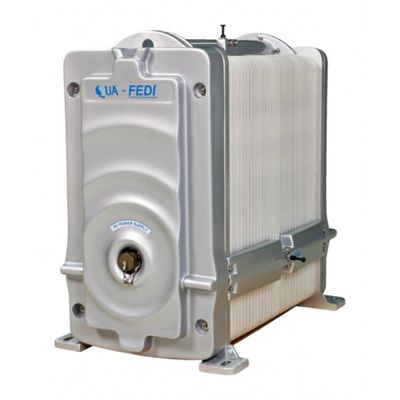
QUA FEDI - Model FEDI-2 -Fractional Electrodeionization Process System
FEDI® stacks are designed to produce high purity water up to 18 MΩ.cm using a patented process with double sets of electrodes per stack. The FEDI® stack is designed to replace mixed bed technology and produces pure water continuously, without the use of regeneration chemicals. Applications include the semiconductor, power, pharmaceutical, and food and beverage industries. FEDI-2 is available in two operating modes: Dual Voltage (DV) and Single Voltage (SV). The stacks contain media on the concentrate side, eliminating the need for a salt injection
- High hardness tolerance stack: Reduces cleaning frequency, while increasing stack reliability
- Reduces system cost: Placed after single Pass RO system
- Low feed pressure: No counter current operation required
- High recovery: Reduced concentrate flow
- Wide range of flows: FEDI-2 stacks comes with different variants to cater to wide range of flow from as low as 0.25 m3/hr (1.1 gpm) to as high as 7.5 m3/hr (33 gpm)
- CE Certified: FEDI-2 stacks comply with 2014/35/EU directive on electrical safety
- Ultra-pure water quality: Produces ultra-pure quality water of up to 18 MΩ.cm.
- Meets water specifications for high pressure boilers and gas turbines, as well as a variety of other application
There are two types of ionic impurities removed in an EDI process; strongly ionized impurities (divalent ions such as Ca, Mg, SO4 and monovalent ions such as Na, Cl and HCO3) and weakly ionized impurities (such as CO2 B and SiO2). Both types of ionic impurities require a different driving force (current) for movement and separation. Strongly ionized impurities require less current, whereas weakly ionized impurities require more. Rather than applying one current to the entire module, the FEDI process differentiates the treatment of weakly ionized and strongly ionized impurities by applying different currents and voltages in a two stage process. This allows a significant portion of strongly ionized impurities, mainly the divalent ions, which can cause precipitation at a higher voltage, to be removed in Stage-1. Subsequently, a higher voltage is applied for removing weakly ionized impurities in Stage-2. The rejected ions from both stages are removed, using separate reject streams, thus preventing hardness precipitation.
Hardness is the scaling component and the main limiting factor for feed conditions in a conventional EDI. By incorporating a two-stage separation process with different voltages the FEDI process is able to:
- Achieve a higher hardness tolerance by having distinctly different concentrate chambers with separate reject streams and thus reducing the potential of hardness scaling.
- Optimize power consumption by using higher electrical current only where required.
- Ensure the best water quality, continuously & consistently by removing a major part of the deionization load in the ‘hardness removal zone’, while residual ionic impurities are effectively removed in the ‘silica removal zone’, which stays in a polishing mode.