
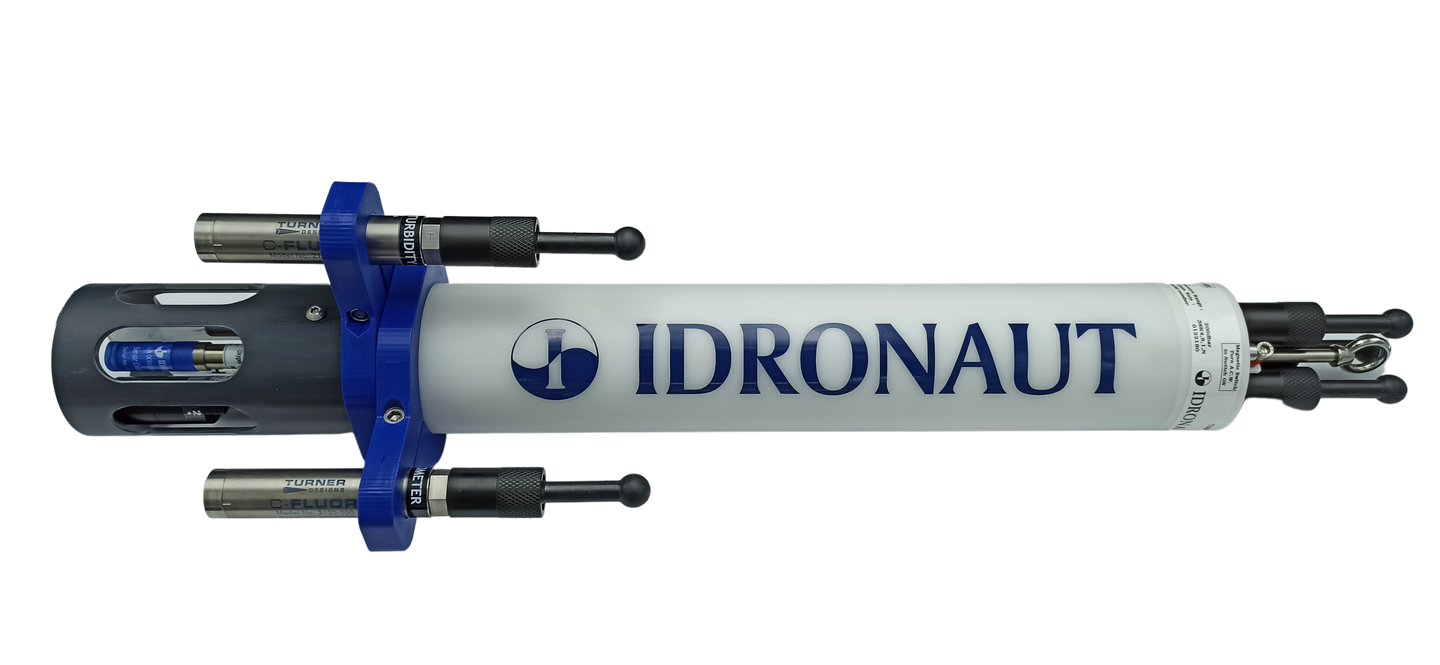

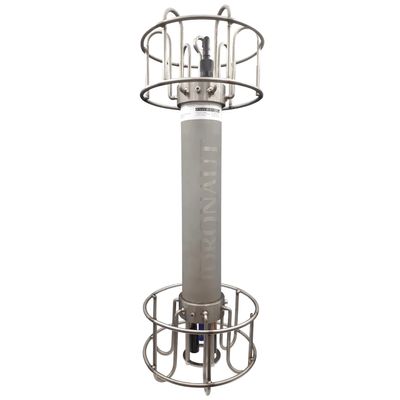
Idronaut - Model OCEAN SEVEN 320Plus -Full-Ocean Multiparameter WOCE - CTD for Oceanography
The OCEAN SEVEN 320Plus WOCE-CTD is equipped with the well-known IDRONAUT full ocean depth, pump-free and long-term stability sensors.
Central to which, is the high accuracy seven-platinum-ring quartz conductivity cell (patented), which can be cleaned in the field without the need for re-calibration. This unique quartz cell employs a large diameter (8 mm) and a short length (46 mm) to guarantee self-flushing and no clogging after long-term deployment even in biologically active waters. Competitors’ sensors, which present few mm only of cell orifice and very long cell length, are prone to clog even if protected by dangerous and poisonous antifouling devices.
The OCEAN SEVEN 320Plus WOCE-CTD multiparameter probe does not require pumps or any other external device to flush the sensors, which minimizes its power consumption and allows the use in Arctica and Antarctica. However, pump is optional.
Data telemetry available for on-line full ocean depth real-time data transmission. Other interfaces like RS422 and wireless Bluetooth® can be optionally installed.
The OCEAN SEVEN 320Plus WOCE-CTD, because of an innovative 24-bit high-speed CT digitizer circuit, provides 40 Hz sampling rate. Furthermore, the highly precise pressure transducer enhances the pressure sensor accuracy/precision to 0.01 % Full Scale (FS).
The OCEAN SEVEN 320Plus WOCE-CTD multiparameter probe can accommodate up to sixteen 16-bit sensor analogue inputs, which can be added at any time, making this Idronaut probe an investment for the future.
- HIGHLY ACCURATE/PRECISE (0.01%FS) PRESSURE TRANSDUCER:
The high-precision 0.01%FS pressure transducer is based on a piezoresisitive bridge, floating on oil, with drift-free sensor interface. Temperature dependency and non-linearity are mathematically compensated by the interfacing electronics. Standard pressure transducers immediately available: 100, 1000, 2000, 4000, 6000, 10000 dbar. - TEMPERATURE SENSOR:
Features a very fast platinum resistance thermometer (response time: 50 ms). Negligible self-heating effect. - CONDUCTIVITY SENSOR:
The high accuracy seven-platinum-ring quartz conductivity cell (patented) can be cleaned in the field without the need for re-calibration. This unique quartz cell employs a large diameter (8mm) and a short length (46mm) to guarantee self-flushing and no clogging after long-term deployment even in biologically active waters. Furthermore, an optional UV LED (280 nm), integrated into the conductivity cell, sterilizes the sample under measurement, thus avoiding the early growth of biofouling inside the quartz measuring cell. - REDUNDANT PAIR OF TEMPERATURE AND CONDUCTIVITY SENSORS:
More reliable operation at sea minimizing risk of data loss. The redundancy principle allows better control of any possible sensor drift during long field campaigns. - OXYGEN SENSOR (7000 m operation):
Features a pressure-compensated polarographic sensor with a replaceable cap or/and advanced optical dissolved oxygen sensor. Both sensor can be installed at the same time. - pH GLASS SENSOR and SOLID GEL REFERENCE ELECTRODE (7000 m operation):
High-pressure low impedance glass membrane pH electrode in conjunction with a unique KCl or NaCl gel double junction reference electrode and a differential pH preamplifier, 1013 ÷ 1014 ohm input impedance. - DATA TRANSMISSION:
Via RS232C interface. Optional interfaces are: long distance (10000 m) telemetry, RS422 and Wireless Bluetooth. - DATA MEMORY:
Allows storage of up to 16M dataset, for each of the 7 standard acquired parameters together with date & time, using the 4 GByte non volatile memory. - OPTIONAL PROBES, SENSORS:
The following sensors, probes are currently interfaced:
» WATER SAMPLER – IDRONAUT MISS, GO 1018, GO 1015, SBE 32C.
» IDRONAUT – High Precision 0.01 % Pressure Transducer.
» IDRONAUT – String and Weight Bottom Sensor.
» IDRONAUT – Optical dissolved oxygen sensor.
» VA500 Sonar Altimeter, 6000 m.
» LI-COR – LI-192SA and LI-193SA Underwater Quantum sensors.
» CHELSEA – MINItracka, Unilux and Trilux Fluorometers.
» WET Labs – C-Star Transmissometer and ECO Fluorometers.
» SEAPOINT – Fluorometers and Turbidity Meter.
» TURNER DESIGNS – CYCLOPS-7FTM, C-FLUORTM Fluorometers.
» TURNER DESIGNS – C3TM / C6PTM Fluorometers.
» BIOSPHERICAL INSTRUMENTS – QSP-2200 – QSP-2300 PAR Sensors.
» VALEPORT – MiniSVS Sound Velocity Sensors.
For more information and warranty policy about Turner Designs products, please visit the manufacturer’s website: C-FLUORTM, CYCLOPS-7FTM, C3TM, C6PTM.
CYCLOPS-7FTM, C-FLUORTM, C3TM, C6PTM trademarks are property of Turner Designs, Inc.
The internal and the optional external submersible battery packs permit continuous probe operation for about 7 and 70 hours respectively. Rechargeable or lithium batteries can also be used. Twelve batteries: 1.2 V, 2.85 Ah, NiMH cells are installed in the internal battery pack.
The OCEAN SEVEN 320Plus CTD can measure, store and transmit sensor data by these modes of operation:
- Pressure:
Data is sampled at regular pressure intervals. Multiple profiles can be obtained by switching the CTD ON and OFF. - Timed:
OS320Plus collects a series of samples and then sleeps for the configured time interval before waking up again and repeating the acquisitions. Time interval can be configured from 0.1s up to 1 day. Battery power is conserved while the probe is in sleep mode. - Conditioned:
Data is sampled at configurable data rates starting when the selected parameter overcomes the configured boundary. Sampling continues until the selected parameter falls below the configured boundary. Whenever the acquisition cycle starts, a configurable sampling rate 0.1..20 Hz is used. Monitoring of the selected parameter occurs at the configurable interval between 0.1s up to 1 day. - Continuous:
Data is sampled at configurable sampling rates starting when the operator switches on the probe. Sampling continues until the probe is switched off. Multiple cycles can be obtained by switching the CTD ON and OFF. - Real-time:
Data is sent to the control system at sampling rates of: 20, 30 and 40 Hz using REDAS-5 software.
The unattended acquisition can be activated by means of a magnetic switch present on the probe top cover. Extension of the internal battery life is automatically obtained through a power management procedure that switches the probe OFF between data acquisitions. The probe is equipped with an internal non-volatile memory which can store up to a 16M dataset, each data set being composed of date, time and measurement of the standard sensors. Stored data is uploaded at the end of the measuring cycles.
The OCEAN SEVEN 320Plus CTD can be configured to be directly interfaced to a personal computer by means of the RS232C serial port or by telemetry. The telemetry and RS422 interfaces remedy the limitations of the RS232C serial interface (cable length and number of conductors). When using the telemetry interface, the Telemetry Deck Unit is required to convert serial, RS232C type signals from a PC communication port, into telemetry signals (and vice versa) which must flow superimposed on the probe power supply along the armoured single conductor coaxial cable.
Probe communication is achieved through one of the two male connectors installed on the top end cap of the probe. A six-pole connector is used for the RS232C and RS422 interfaces and for the power input, while, a two-pole connector is used for the telemetry interface.
All the sensors installed in the OCEAN SEVEN 320Plus CTD (see table for SENSOR SPECIFICATIONS) are manufactured by IDRONAUT and are exported all over the world. They are used by several other multiparameter probe manufacturers. All sensors have extremely low response time: 50 milliseconds for physical parameters (CTD) at 1 m/s profiling speed and 3 seconds for chemical parameters. CTD sensor high resolution and accuracy are obtained because of the advanced sensor conditioning circuits and the 24-bit Sigma Delta A/D Converters.