- Home
- Companies
- Newland Entech Europe
- Products
- Newland - Gas Source Selection Ozone ...
Newland - Gas Source Selection Ozone Generators
Ozone Generator system can use air or oxygen as the gas source according to working conditions. Operations must ensure the inlet gas quality has a dew point lower than -60ºC and has no dust oil.
Air source is usually produced by on site air-treatment equipment. Oxygen can be by an on-site oxygen generator, liquid oxygen or pipeline oxygen.
The rated ozone concentration of Newland air-feed ozone generators are 35 mg/l and the max is 70 mg/l. the rated concentration of oxygen-feed generators are 150 mg/l, and the max ozone concentration can reach 270 mg/l. users can choose the appropriate gas source according to the requirement of ozone concentration. Ozone equipment and operation cost can be quite different because of the different gas sources. In addition, the noise problem when producing air and oxygen on site should be taken into consideration.
OPERATING COSTS
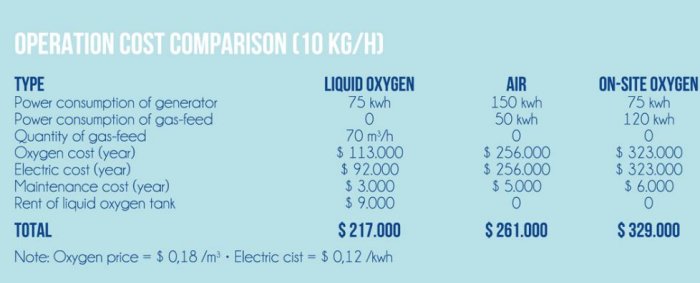
The main operational costs include the cost of the gas source and the electricity for the ozone generator, if cooling water cannot be reused, the water consumption also needs to be taken into consideration. The operation costs of various gas sources are quite different. The following table lists the operation cost comparison among liquid oxygen, air, on-site oxygen.
Outlet ozone concentration of oxygen-fed ozone systems can be adjusted greatly within the operating range (for example 0 – 270 mg/l). However, long term operating requirements should be taken into consideration for costs optimization when selecting system.
Taking oxygen-fed ozone system as an example, the operational cost includes the cost of oxygen and power consumption cost of ozone generator. Increasing ozone concentration may reduce oxygen consumption, but it would increase power consumption per kilogram of ozone.
The optimal operation concentration of Newland oxygen-feed ozone system is between 150 mg/l – 160 mg/l. The total operation cost is the lowest at this time. If the oxygen price is $0,18/m3 and the electric cost is $0,12/kwh, the oxygen cost and electric cost are about $2,28 per kilogram of ozone. The rated ozone concentration of the NLO ozone system is 150 mg/l, and the corresponding ozone output is rated output.
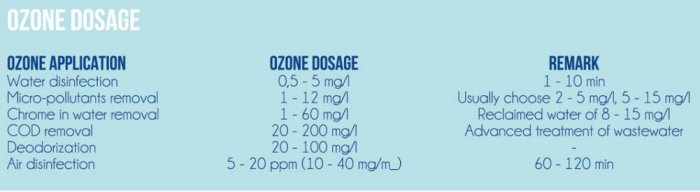
For each specific application, a reasonable ozone dosage can be determined through lab experiment or pilot test according to local conditions and requires treatment effect. If the ozone dosage is too low the required treatment will not be achieved. Too high an ozone dosage may not be economic, and may even produce toxic by-products, such as bromate. There is a great range of required ozone dosage depending on the application.