- Home
- Companies
- Geneaid Biotech Ltd.
- Products
- Geneaid - DNA Isolation Kit (Bacteria) ...
Geneaid - DNA Isolation Kit (Bacteria) (GEE150, GEE1.5K)
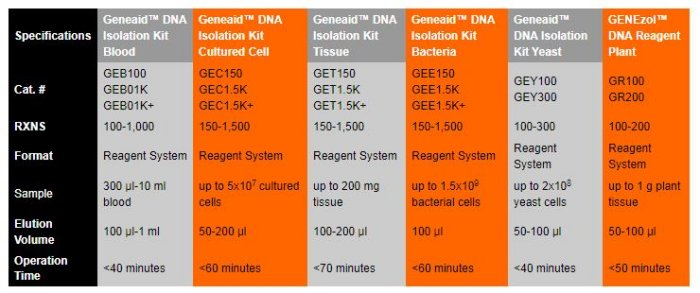
The Geneaid™ DNA Isolation Kit (Bacteria) offers a simple and gentle reagent DNA precipitation method for isolating protein free, high molecular weight genomic and viral DNA from Gram (+) positive and Gram (-) negative bacteria cells, suitable for archiving or sensitive downstream applications. This highly versatile solution based system can be scaled proportionately in order to satisfy larger sample volumes providing a convenient sample-storage procedure with minimal hands on time. Initially cells are lysed in the presence of detergents and a proprietary DNA stabilization solution followed by RNase A treatment. Once proteins and other contaminants are removed DNA is precipitated then rehydrated. The high quality extracted DNA is ready for use in a variety of downstream applications.
- Isolate high molecular weight DNA for archiving or sensitive downstream applications
- High yield, High quality DNA (A260/A280 = 1.8-2.0)
- Sample: 0.5-1.5 x 10⁹ bacteria cells
-
Easily scalable to satisfy larger bacteria sample volumes
- Minimal hands on time
- Convenient, simple and gentle reagent DNA precipitation method
- Storage: dry at room temperature (15-25°C) for up to 2 years, Lysozyme is shipped at room temperature and should be stored at -20°C for up to 1 year
- DNA archiving, PCR, AFLP, RFLP/PADP, Southern Blotting, Real-time PCR
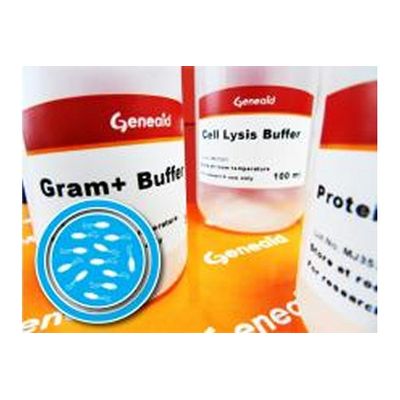
- Cell Lysis Buffer
- Gram+ Buffer
- Protein Removal Buffer
- DNA Hydration Buffer (10 mM Tris-HCL, 1 mM EDTA, pH8.0)
- RNase A (10 mg/ml) - not included with GEE1.5K
- Lysozyme - not included with GEE1.5K
The quality of the Geneaid™ DNA Isolation Kit (Bacteria) is tested on a lot-to-lot basis according to Geneaid`s ISO-certified quality management system. Genomic DNA is isolated from 0.5-1.5 x 10⁹ bacteria cells. The isolated DNA (5-15 µg with an A260/A280 ratio of 1.8–2.0) is quantified with a spectrophotometer and analyzed by electrophoresis.