- Home
- Companies
- Genesys International Limited
- Products
- Genesys - Model AG8 - BWRO Antiscalants

Genesys - Model AG8 -BWRO Antiscalants
Phosphonates offer the best combination of scale inhibiting efficiency, metal ion sequestering and stability allowing reverse osmosis plants to operate at higher recovery rates thus reducing pumping costs.
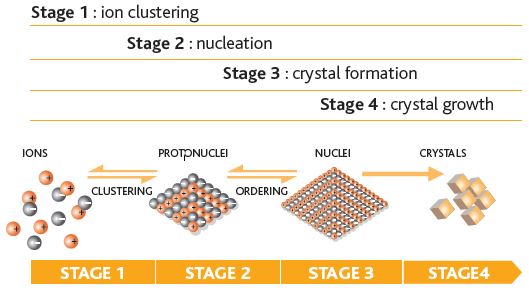
During the Reverse Osmosis process the solubility of scaling species may become “supersaturated”, eventually leading to deposition on the membranes.
This process can be divided in 4 main stages:
Insoluble deposits start forming on the membrane surface, causing flux and salt rejection to decrease, and resulting in higher long-term operational costs (through increased pumping pressure, cleaning frequency and membrane replacement). The most commonly detected scales are calcium carbonate and calcium sulphate, silica and other less common scales can also be problematic. Some membrane deposits can be difficult to remove, and irreversible membrane damagemay result. Preventing salt precipitation is therefore paramount.
Scale Prevention
Various different techniques are available which have been traditionally used to control scaling potential in RO feed waters. They include the removal of calcium and magnesium ions from water by base exchange resin softening. This method requires capital equipment and salt to regenerate the resin. Acid injection lowers the scaling potential of calcium carbonate and calcium phosphate by reducing the feed water pH. It has no effect on calcium sulphate and a detrimental effect on silica solubility. A significant drawback of acid dosing is the handling problems and quantity required to have a small reduction of pH and effect on scale inhibition.
Antiscalants offer some advantages compared to other methods, for example capital and operational costs are lower than water softening and they can be designed to control specific problematic species. However, not all antiscalants are equal : different molecules mean varying modes of action and uneven levels of efficacy.
Antiscalants can disrupt the scaling process through a variety of mechanisms :
- Threshold inhibition : the antiscalant acts at stage 2 of the crystal formation process, inhibiting the ordering of protonuclei and thus preventing nucleation. Active compounds : polyphosphates, polymetaphosphates, phosphonates
- Crystal distorsion : the antiscalant acts at stage 3, disrupting crystal formation and thus preventing crystallization.
- Active compounds : organic polymers, mainly polyacrylic, polymaleic or polycarboxylic acid
- Dispersion : dispersants use electrical repulsion to maintain crystals in suspension, preventing them from adhering to the membrane surface and to each other
- Complexation : ability to attract ions to create soluble and stable molecules. Active compounds : chelating agents such as EDTA The majority of modern antiscalant formulations are based on polymers or phosphonates.
Polymer-based antiscalants prevent scale formation mainly through crystal distortion and also have mild dispersant and threshold properties. Although they are relatively cheap, Polymers have technical limitations when compared to phosphonate chemistry :
- they do not sequester metal ions
- polyacrylates can react with iron to produce insoluble iron acrylate
- they provide a potential nutrient source for microorganisms promoting membrane biofouling
- limited efficacy against silica
Although not the universal answer to scaling, phosphonates offer the best combination of efficiency, stability and ability to control a variety of different scaling species, under different conditions of temperature, pH at low dose rates. In comparison to polymers phosphonates have the following activity :
- sequester iron
- good quality phosphonates are proven not to contribute to system biofouling potential
- broad-spectrum against a broad range of scales and foulants, including silica
- contribute dispersant effect on colloids and organics and a
- moderate chelating effect
- do not contribute to water eutrophication or algal bloom
Scale Specific Antiscalant
Increased demands for pure water and scarcity of available water in key areas has led to the installation of membrane systems fed on challenging feed waters which require a dedicated approach to antiscalant selection :
- ground waters in arid and desert areas frequently contain high levels of calcium, magnesium, silica and sulphate
- tertiary effluent recycling systems typically face high levels of phosphate
- extensive extraction from aquifers can lead to the deterioration of the feed water chemical composition over time.
In order to cope with these situations and allow plants to be operated efficiently at high recovery rates with minimal cleaning requirement, Genesys has developed a range of speciality antiscalants which target specific scaling species : Genesys SI, Genesys PHO, Genesys BS, Genesys MG and Genesys CAS.
Due to the complex nature of feed water scaling in RO feed waters Genesys has developed a software package to allow us to select the technically correct product at the optimum dose rate.
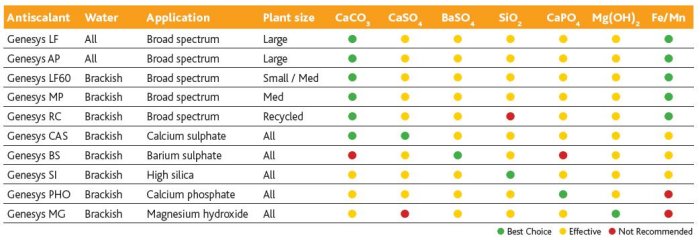
- Antiscalants do not only prevent scale, they can also help reduce capital and operational costs by enabling :
- increased recovery rates (reduced feed water, power consumption and effluent discharge) acid dosing reduction or suppression
- decrease in cleaning frequency (lower downtime, chemical consumption and membrane stress)
- extended membrane life
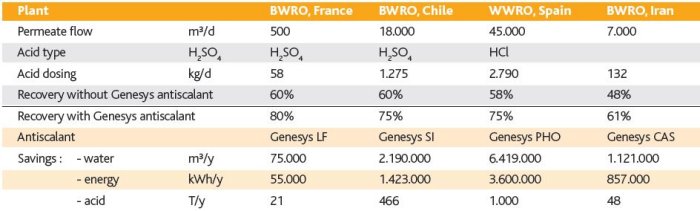
Correct antiscalant selection should therefore be implemented at the design stage in order to achieve maximum benefit, but existing plant conversion may translate into direct operational gain as shown in the case study data below: