


- Home
- Companies
- GEOfabrics Limited
- Products
- GEOfabrics - Cuspates
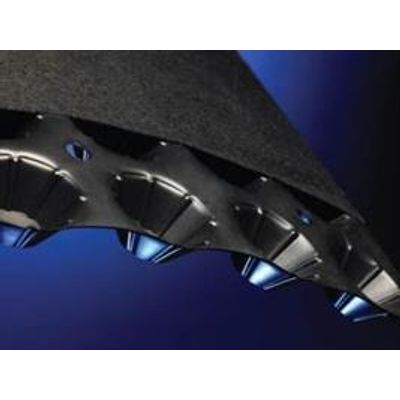
GEOfabrics - Cuspates
Cuspates are commonly used as a component in a geocomposite, in conjunction with a geotextile filter, in applications like gas protection systems, cut off walls around contaminated land, rear of bridge abutments and retaining walls, and around buried structures.
The sheet is formed in an extrusion process, whereby semi-molten polymer is extruded through a flat die, with normal thicknesses from 0.4 to 2mm. These impermeable membranes are vacuum formed into geocuspated cores between 6mm and 40mm thick, depending on the mechanical and hydraulic properties required.
Vacuum forming is a simplified version of thermoforming, whereby a sheet of plastic is heated to a forming temperature, stretched onto a single-surface mould, and forced against the mould by a vacuum (suction of air).
An alternative to Vacuum forming involves a continuous process where semi-molten polymer is formed between two corresponding rollers with male and female forming points. This process allows us to control quality from polymer source through to finished cuspated drainage core.
Typical uses are:
- Green Roof systems
- Horizontal drainage systems
- Vertical Drainage systems
- Gas Venting
GEOfabrics’ Cuspates are named in accordance with the thickness of the material; e.g. CO20 = 20mm thick. GEOfabrics’ cupates are also supplied as composites with a geotextile filter bonded to either one side (FC) or both sides (FCF).