


- Home
- Companies
- Geopier, a Division of CMC
- Products
- Geopier - Impact System for Soil ...
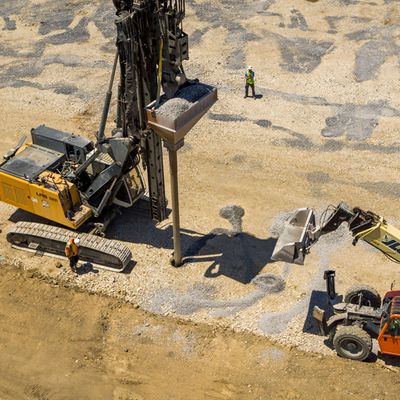
Geopier - Impact System for Soil Stabilization
The Geopier Impact System is engineered to tackle challenging soil conditions where traditional drilling techniques fail to maintain open boreholes. This system utilizes a displacement method, deploying a steel pipe mandrel with a patented compaction chamber to infiltrate caving soils and efficiently construct piers. By advancing through unsuitable soils to a specified depth, the Impact System enables the creation of densely packed Rammed Aggregate Piers (RAPs), allowing for higher load-bearing capacities and excellent settlement control. Suitable for use below the groundwater table, the process ensures minimal contamination and maintains the integrity of the aggregate. This system is adept at handling various soil types, including caving sands, soft clays, and liquefiable soils. Its application spans multiple industries, from commercial and residential projects to wind farms and industrial facilities, illustrating its versatility and reliability in diverse geotechnical applications.The Geopier Impact® system is our solution to soils that simply won’t stay open during drilling. Impact piers are a displacement type system that uses a steel pipe mandrel outfitted with a patented compaction chamber to penetrate through caving soils and construct piers from the bottom up. This installation method allows for the construction of high-quality Rammed Aggregate Piers (RAPs) below the groundwater table without having to worry about contamination and/or fouling of the aggregate. The end result is a dense column of aggregate surrounded by stiffened matrix soils that provide excellent settlement control and allow for higher bearing capacities.
- Caving sands below the groundwater table and soft squeezing clays and silts
- Organic soils after the addition of grout to the aggregate
- Liquefiable soils
Geopier Impact piers are installed by advancing a displacement mandrel through unsuitable soils to a desired design depth. Once at depth, the mandrel is withdrawn several feet to allow open-graded aggregate to flow into the annular space. The mandrel is then redriven to create a densified 2-foot-thick lift of aggregate. These steps are repeated up to the ground surface to create a dense column of aggregate surrounded by stiffened matrix soils.