


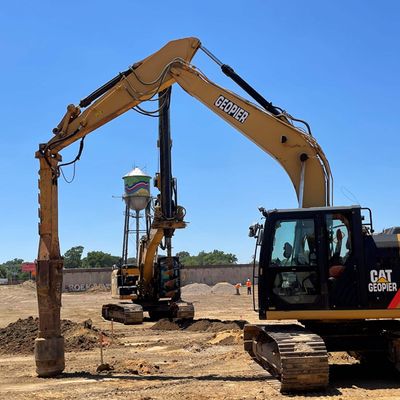
Geopier - Model GP3 -Rammed Aggregate Pier Systems
The Geopier GP3 system is a foundational reinforcement method specially designed for non-caving soil conditions. This technique involves a 'drill and fill' approach that replaces unsuitable soils with a Rammed Aggregate Pier (RAP) composed of well-graded aggregates. The construction process uses a track-mounted auger and a proprietary tamper to form dense columns, which improve soil stiffness and support higher bearing capacities, achieving significant settlement control. The GP3 system, known for its versatility and reliability, has been implemented in numerous successful projects across various applications, including commercial structures, parking garages, and industrial facilities. Its installation process involves precise drilling to specific depths, followed by systematic layering of aggregates, which enhances soil coupling. It is notable for exerting lateral pressures that contribute to enhanced matrix soil stabilization, making it suitable for diverse geotechnical engineering needs.
The Geopier GP3 pier system is the primary “drill and fill” solution. This system is ideal for non-caving soils that stay open during drilling. GP3 piers are constructed using a track-mounted auger to drill out unsuitable soils and a patented track-mounted tamper to construct the Rammed Aggregate Pier (RAP) elements. The end result is a dense column of aggregate surrounded by stiffened matrix soils that provide excellent settlement control and allow for higher bearing capacities. The GP3 system is one of Geopier’s oldest systems, with several thousand successful projects in the ground.
- Non-caving soils such as clays, silts, and sands with high fines content
- Caving soils with the use of temporary casing
- Organic soils using cemented treated aggregate (CTA)
The Geopier GP3 installation process consists of drilling out unsuitable soils to a desired design depth and then constructing a dense column of aggregate using a patented tamper. The pier is constructed in 2-foot-thick lifts using well-graded aggregate, open-graded aggregate, or sand. The installation process imparts significant lateral pressures into the adjacent matrix soil, which creates excellent coupling and stiffens the soil.