


- Home
- Companies
- EWT Eckert Wassertechnik GmbH
- Products
- Granular Activated Carbon Filter
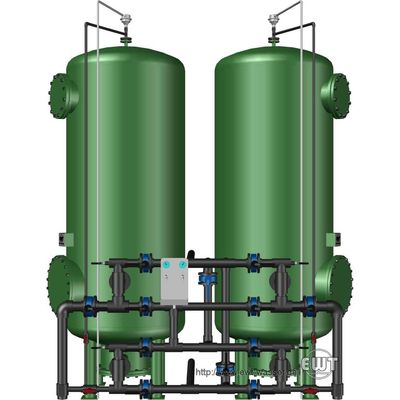
Granular Activated Carbon Filter
In water treatment, a granular activated carbon filter (short: GAC filter) serves for removal of certain dissolved or suspended molecular substances, or of certain emulsified liquids, primarily by means of adsorption. The adsorbent (or "filter" material) is a packed bed of granular activated carbon, with equipment and filter vessel design (but not process design) being basically identical to actual bed filters, e.g. →sand filters. Typical applications are removal of organic compounds (e.g. measured by TOC = total organic carbon), removal of oil and grease, or removal of chlorine. With increasing service life, the granular activated carbon adsorbent will eventually become depleted, and need to be replaced. This is due to the useable active surface of the adsorbent being reduced by adsoprtion of the adsorbate, but for certain applications also biological fouling, or – in case of chlorine removal – consumption of the adsorbent due to chemical reactions.
As a side effect, a GAC filter also acts as an actual filter, thus possibly requiring periodic backwash with water in order to remove filtrated suspended solids from the filter bed, depending upon the raw water quality.
- Removal of organic compounds from water (TOC), for example surface water or contaminated water from sub-surface sources.
- Removal of oil and grease from water, for example contaminated →condensate in boiler feed ater treatment.
- Removal of chlorine from water, for example chlorinated water from municipal supply, in order to protect downstream ion exchange or membrane separation plants.