


EWT Eckert Wassertechnik GmbH products
Filtration
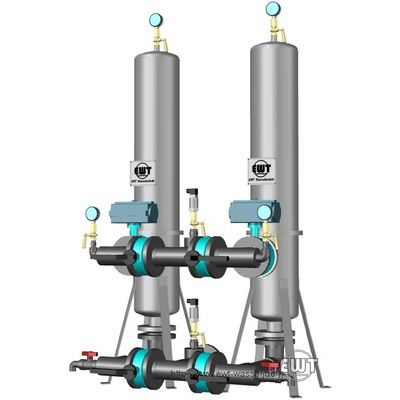
Cartridge Filter
Within the scope of water treatment, filtration is a mainly physical process for removal of suspended solids from liquids. The liquid to be filtrated flows through a filter medium, which results in the suspended solids being retained by this filter medium. A cartridge filter (in case of certain designs also: candle filter) is a vessel for filtration, with an arrangement of filter cartridges serving as filter medium. Filter cartridges are available in different designs and material, for example melt-blown cartridges made of PP or wound cartridges made of cotton. With increasing service life, the differential pressure between the filter inlet and out increases for a given volume flow, as more solids are being retained within the filter medium. Eventually, the filter medium needs to be either backwashed or replaced. Filter cartridges are usually replaced, certain types are within limitations also suitable for backwashing.
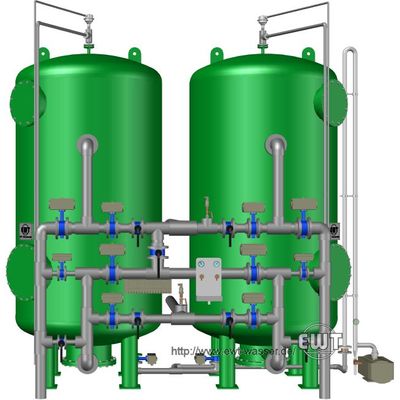
Sand Filter
Within the scope of water treatment, filtration ist a mainly physical process for removal of suspended solids from liquids. The liquid to be filtrated flows through a filter medium, which results in the suspended solids being retained by this filter medium. A sand filter ist a vessel for filtration, with a filter bed consisting of silica sand serving as filter medium. With increasing service life, the differential pressure between the filter inlet and out increases for a given volume flow, as more solids are being retained within the filter medium. Eventually, the filter medium needs to be either backwashed or replaced. A sand filter requires periodic backwash, either with water only, or with both air and water. During backwash, waste water needs to be discharged.
Adsorption:
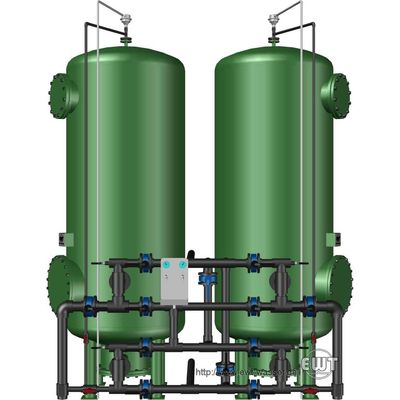
Granular Activated Carbon Filter
In water treatment, a granular activated carbon filter (short: GAC filter) serves for removal of certain dissolved or suspended molecular substances, or of certain emulsified liquids, primarily by means of adsorption. The adsorbent (or "filter" material) is a packed bed of granular activated carbon, with equipment and filter vessel design (but not process design) being basically identical to actual bed filters, e.g. →sand filters. Typical applications are removal of organic compounds (e.g. measured by TOC = total organic carbon), removal of oil and grease, or removal of chlorine. With increasing service life, the granular activated carbon adsorbent will eventually become depleted, and need to be replaced. This is due to the useable active surface of the adsorbent being reduced by adsoprtion of the adsorbate, but for certain applications also biological fouling, or – in case of chlorine removal – consumption of the adsorbent due to chemical reactions.
Ion Exchange:
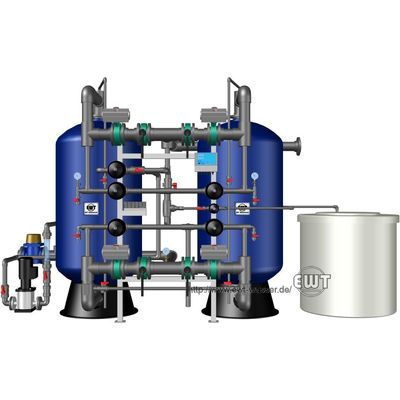
Ion Exchange Softening
Softening is an ion exchange process for removal of calcium and magnesium ions from water. The concentration of these ions in water is also called water hardness. A softener is a vessel filled with a resin bed, consisting of strong acid cation exchange resin in sodium form. While water flows through the resin bed, calcium and magnesium ions dissolved in that water are exchanged for sodium ions. Accordingly, softening is not a demineralisation process. Instead, the equivalent concentration of the total dissolved solids remains constant before and after softening. With increasing service life, the ion exchange resin depletes, and then needs to be regenerated with sodium chloride brine.
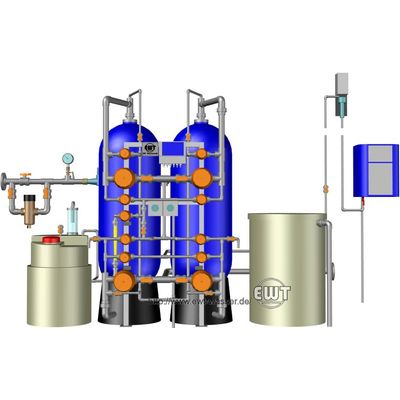
Ion Exchange Dealkalisation
Dealkalisation (also: dealkalization) is an ion exchange process for partial demineralisation of water by exchanging certain calcium and magnesium ions for hydrogen ions. For dealkalisation, water flows through a vessel filled with weak acid cation exchange resin in hydrogen form. This results in an amount of calcium and magnesium ions which is chemically equivalent to the alkalinity of the that water to be exchanged for hydrogen ions. The hydrogen ions then react with hydrocarbonate to carbonic acid, and further to water and carbon dioxide. For removal of that carbon dioxide, a CO2-degasser is often used downstream of a dealkalisation plant.