


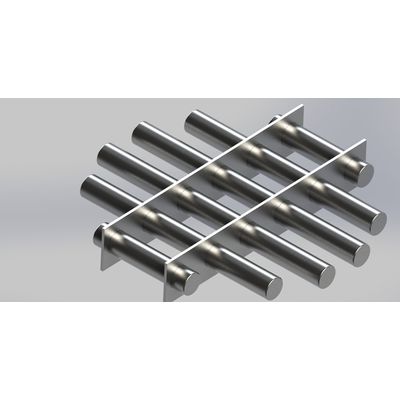
MSI - Grate Magnets for Fine Separation and Free-Flowing Dry Solids
MSI’s tubular magnetic circuit forms the core technology for numerous solutions in fine separation and free-flowing dry solid applications. It leverages magnetic elements to create robust, evenly distributed magnetic fields within stainless steel tubing. Multiple tubes can be combined for enhanced coverage, whether for small or large areas. This circuit is integral to products like grate magnets and drawer-in-housing units, and extends to pneumatic and hydraulic solutions like bullet magnets and T-Traps. The tubular magnetic circuit can use different tubing thicknesses to improve durability or performance. Customers can select between ceramic and rare earth magnet elements to meet varied strength and temperature requirements. Standard configurations employ 1” diameter stainless tubes within heavy-duty stainless steel frames, though custom configurations are also available. MSI’s drawer-in-housing units are particularly effective for removing ferrous contamination in dry processing, utilizing multiple offset rows of magnetic tubes to maximize contact and separation. Cleaning options range from manual to EZ-Clean to fully automated self-cleaning, catering to different volumes of tramp metal and operational requirements.
Tube & Grate Magnets
The most basic conception of the tubular magnetic circuit is the tube magnet itself. These are available in a wide variety of sizes, but typically are 1” in diameter and 4” to 48” long with magnetic poles approximately every inch along the length. Multiple tubes can be combined to make grate magnets (see image).
Drawer-in-Housing Magnets
MSI’s drawer-in-housing is designed for removal of ferrous in various dry processing applications. It utilizes the tubular magnet design placed in a drawer with either a single row or, more commonly, multiple offset rows with alternating centers. The product flows through the top and over the offset magnetic tubes, causing it to slow down and contact multiple tubes as it cascades through the separator. This increases the amount of ferrous exposed to the magnetic poles, thus maximizing separation. The drawer-in-housing is available in almost any configuration the customer can imagine, but primarily these units fall into one of three different cleaning categories: manual clean, EZ-Clean, and self-cleaning. The cleaning style used is typically based on volume of tramp metal since magnets must be kept clean to be effective.
Drawer-in-Housing Cleaning Options
MANUAL CLEAN
Still part of the “drawer” style, the manual clean drawer in housing is effectively a grate or multiple grates in a housing. This is the most basic configuration, popular in applications that either do not need frequent cleaning (such as a finishing step after a primary magnetic separator) or when a very specific finish on the working surfaces is required (such as pharmaceutical applications). The manual clean drawer in housing must be cleaned by hand and cannot protect against ferrous during the cleaning process.
EZ-CLEAN
The EZ-Clean drawer-in-housing employs a stripper plate and wipers that wipe off the magnetic tubes. As the drawer assembly is pulled out, the tubes pass through the wipers and ferrous is retained against the stripper plate. Once out of the magnetic field, the ferrous falls off (typically into a container) and the drawer can be returned to the working position. This cleaning cycle can be done in a matter of seconds, greatly reducing down time in time-sensitive applications. By employing multiple stripper/wiper assemblies, protection does not necessarily need to be interrupted during the cleaning cycle.
SELF-CLEANING
The Self-Cleaning drawer in Housing is the same as the EZ-Clean, but uses pneumatic cylinders to actuate the cleaning cycle. These are especially popular with systems hooked up to an automated control system or when operator access is difficult.
Material :
- Ceramic
- Rare earth (N50 and N52 grades standard, high temperature, and others available)
- Alnico
- Hybrids and combinations
Configurations :
- Tube and Grate
- Drawer-in-Housing
- Inline Pneumatic (see Bullet Magnet)
- Inline Hydraulic (see T-Trap)
- Customized spacing (1.5” – 3” centers, typically), others available
- Multiple Rows (typically 2 – 4)
- Surface Gauss up to 12,000Gs plus in 1” tubing
- Custom tubing diameters
Cleaning :
- Manual
- Tube-in-sleeve
- EZ-Clean with wipers
- Self-Cleaning
Other Custom Options
- Customized housings and flange transitions
- Various grades of finish, such as standard industrial, fully welded, ground smooth, and polished for food applications
- Surface coatings (e.g. plated or Nedox)
- Diverters
- Custom tube spacing for materials that do not flow freely or “bridge” across tubes.
- Custom tube wall thickness/magnet material for maximum protection.
- Various grades of stainless steel