- Home
- Companies
- Global Technology Systems (GTS)
- Products
- GTS MultiFLOW - Mass Flowmeter for ...
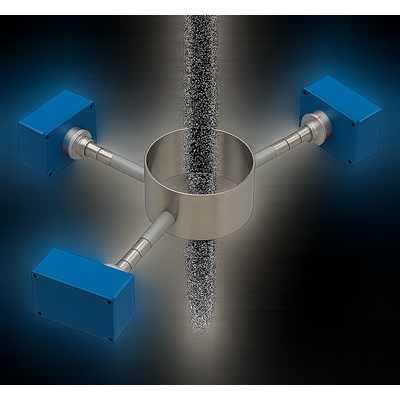
GTS MultiFLOW - Mass Flowmeter for Solids In Large Pipes Or Chutes
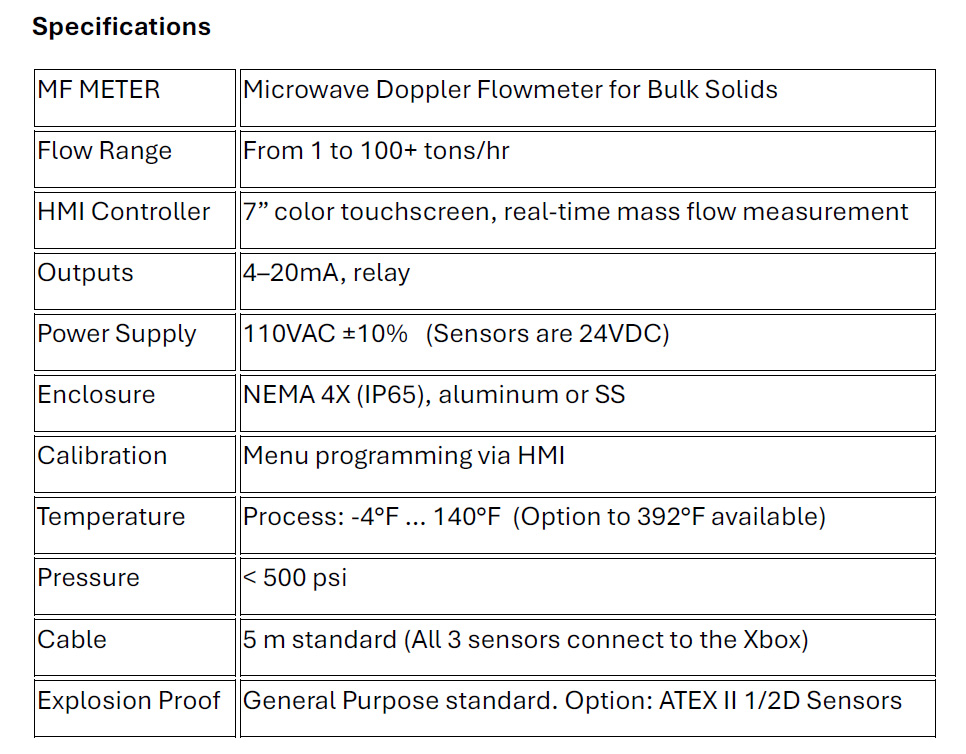
Triple Sensor Input. Free fall or Dilute-phase pneumatic conveying. True Mass Flow Output. For pneumatic conveying and freefall processes (typically 1 to 400 tph). Easy installation and start up procedures for calibration. Integral solids flow measurement for all types of powders, granules, flakes, chips, etc.. Install on pipe diameters greater than 8 inches (chutes and ducts need to be reviewed). Long-term stable, reliable, and redundant. Sensor supply for connections up to 1000 m. Galvanically separated RS485-Interface for PLC-Connection. Analog 4-20 mA output, RS485 and alarm relay.
MF METER (Solids Flow) uses the principle of the Doppler effect.
A microwave signal is emitted, thereby generating an electromagnetic field inside the pipes. The particles passing in movement in this field generate a signal that varies in amplitude and frequency. The rate of flow is computed from a mathematical analysis combined with a calibration (with real measurements).
The Smart HMI Controller combines the raw signals of all 3 sensors and produces an accurate overall flow measurement usually within +/- 1-3% FS. This intelligent system compensates for material randomly flowing at different concentrations within the pipe diameter.
Why Use Three MF METERs?
- Eliminates Flow Profile Bias: Product rarely flows uniformly in wide pipes or chutes. Averaging three independent measurements eliminates errors caused by asymmetrical flow.
- Redundant Measurement: Ensures continued operation if one sensor fails.
- Improved Accuracy: Captures localized variations, delivering a reliable overall mass flow value.
Beyond the working principle, the technology developed for MultiFLOW METER allows the equipment to compensate for variations in:
- Concentration
- Speed of particles
- Granulometrics
- Temperature
- Buildup
FOR BETTER PRECISION.
FOR BETTER REPEATABILITY.
FOR BETTER STABILITY OVER TIME.
Contactless measurement
Very easy-to-use device
No maintenance
No remote electronic handling
SENSOR MOUNTING PROCEDURE :
- Position the circlip on the waveguide regarding depth of the bushing + valve +
bracket + thickness of the pipe.
For optimal operation, the sensor head should be at least flush with the inside of the
pipe or slightly inside.
Use a depth gauge to determine the exact depth - Unscrew the headless screws of the blue holder bracket.
- If you have a valve, open the valve to allow the passage of the waveguide.
- Insert the waveguide sensor proper depth.
- Secure the sensor with the screws.