


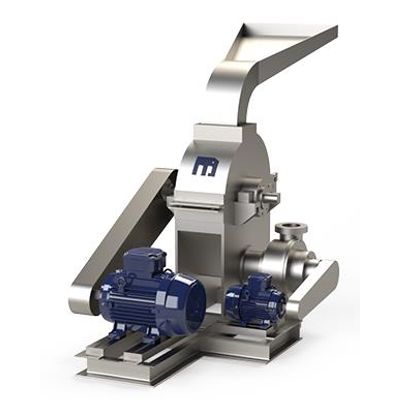
DP Pulverizer - Hammer Mills
DP Pulverizer Hammer Mills deliver rugged, high-throughput grinding for coarse to medium materials—ideal for agriculture, recycling, food, biomass, and chemical applications. Our Hammer Mills lead the industry in engineering, innovation, performance, & quality, all while keeping a realistic price that everyone can afford.
A hammer mill is a type of mechanical size-reduction equipment that uses high-speed rotating hammers to crush, grind, and pulverize materials through repeated impact. It is one of the most widely used milling technologies in industrial processing due to its simplicity, versatility, and high throughput capability.
Hammer mills reduce material size by striking particles with rapidly rotating hammers and forcing them through a perforated screen or grate. Particle size is controlled by hammer speed, screen size, and feed rate, making hammer mills suitable for a wide range of coarse to moderately fine grinding applications.
Hammer mills are commonly used across industries such as food processing, agriculture, chemicals, pharmaceuticals, recycling, biomass, minerals, and industrial materials.
Hammer mills have remained a staple in size reduction for decades because they offer:
- Simple, proven operating principles
- Ability to handle a wide range of materials
- High throughput at relatively low cost
- Rugged construction for industrial environments
They are often the first stage of size reduction, preparing material for finer downstream milling when required.
Unlike jet mills or pin mills, hammer mills rely on direct mechanical impact between the hammer and the material.
Key distinctions include:
- Suitable for coarse to medium-fine grinding, not ultra-fine micronization
- Capable of processing tough, fibrous, or heterogeneous materials
- More tolerant of feed size variation
- Higher material contact and wear compared to non-contact mills
This makes hammer mills especially valuable in applications where durability and throughput matter more than ultra-tight particle size control.
Hammer mills are typically used to achieve particle sizes ranging from:
-
~0.5 mm to several millimeters, depending on screen size and configuration
With fine screens and proper configuration, some hammer mills can achieve finer sizes, though this is not their primary strength.
Hammer mills are well suited for a wide range of materials, including:
- Grains and agricultural products
- Sugar, salt, and food ingredients
- Spices and seasonings (coarse grinding)
- Biomass and wood products
- Chemicals and salts
- Minerals and industrial materials
- Recycling streams and waste materials
Their ability to handle tough and inconsistent feedstocks makes them highly versatile.
In industrial applications, hammer mills are often integrated into complete processing lines, serving as:
- Primary size reduction equipment
- Pre-grinding units before fine milling
- Conditioning mills ahead of classification or separation
When engineered correctly, hammer mills provide stable, reliable performance in demanding production environments.
Hammer mills are used in countless industries for bulk material size reduction
Agriculture
Grinding corn, soybeans, and other animal feed ingredients.
Biomass & Wood
Processing wood chips, bark, and agricultural waste.
Food Processing
Crushing spices, sugar, salt, starches, and root vegetables.
Pharmaceuticals
Coarse grinding of herbs, and medicinal plant materials.
Chemical Industry
Pulverizing resins, fertilizers and general chemicals.
Mining & Minerals
Breaking down soft rocks, coal, limestone, and gypsum.
Recycling
Size reduction of paper, plastics, rubber, e-waste, and more.