


- Home
- Companies
- Hydrogen Components, Inc.
- Products
- HCI - Metal Hydride Thermodynamic ...
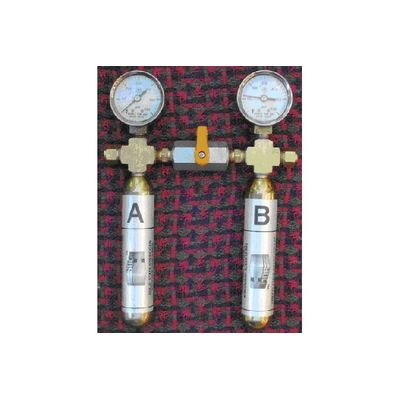
HCI - Metal Hydride Thermodynamic Demonstration Devices
Metal hydrides are compounds formed by reactions of metals with hydrogen. Some metal hydrides equilibrate with hydrogen gas at positive gauge pressures near room temperature. The changes in free energies, enthalpies and entropies of forming and decomposing two different metal hydrides may be determined with the simple device shown in Figure 1. If you are familiar with this device and know how to use it, please scroll to the bottom of the page to buy it, the instructions and test questions.
Students of thermodynamics are asked to keep three new concepts (free energy, enthalpy and entropy) in mind while trying to understand the importance of Gibbs` Function:
G = H - TS
After we open the valve in Figure 1, hydrogen flows from Tank B into Tank A. The metal hydrides inside the two tanks manifest free energy, enthalpy and entropy changes in ways that appeal to the intuition. Pressurized hydrogen gas, indicated on the pressure gauges of the HTT1, clearly has the ability to do work (ΔG) by moving a piston. As hydrogen gas is absorbed or desorbed, the heat of reaction (±ΔH) can be felt by touching the tanks. The evolution of a cloud of gas molecules (e.g., the background of this web page) from a crystalline solid represents an obvious increase in disorder (ΔS).
As metal hydride B (right side, Fig. 1) desorbs hydrogen gas, Tank B becomes cold to the touch (+ΔH flows in from the hand). Absorption by hydride A (left side, Fig. 1) makes Tank A hot to the touch (-ΔH flows out to the hand). This reinforces the notion that the terms in Gibbs` Function are signed quantities.
These clear qualitative examples of free energy, enthalpy and entropy changes make it easier to move forward into quantitative studies.
If you don`t intend to go further with the experiments explained below, the low cost HTT1 shown in Figure 1 will be adequate. The tanks are made of steel and must not be submerged in water. If you intend to follow the instructions below, you need the HTT2 with stainless steel tanks.
Clausius-Clapeyron Equation
The formation and decomposition of metal hydrides is comparable to condensation and vaporization of liquids. Advanced students may wish to look deeper into the changes that occur in the solid phase as hydrogen (H1) comes and goes. The activity of H1 in the solid state is expressed as P 0.5 .
The pressure of hydrogen gas in equilibrium with a metal hydride increases rapidly with temperature. If we put a metal hydride reaction vessel into a variable temperature water bath (don`t do this with the HTT1), we can record equilibrium pressures at various temperatures.