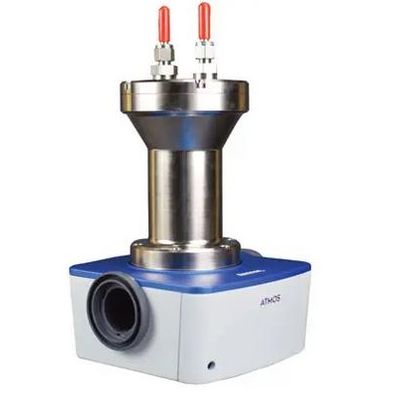
Specac - Model Atmos -Heatable Long Pathlength Gas Cells
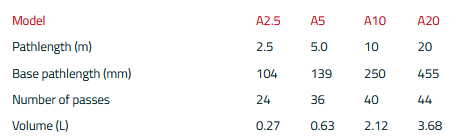
Better value long pathlength gas cell Atmos is our range of long pathlength gas cells for measuring the infrared spectra of trace gases and vapors. Available in fixed pathlengths of 2.5, 5.0, 10.0, 20.0 meters for maximum versatility. Each cell has been individually optimized for maximum optical throughput and signal-to-noise
- Wide pathlength range (2.5 to 20m)
- Vacuum (torr) (3 x 10⁻³) to 125 psi operation (80 psi for 20m version)
- Up to 200 °C with heating jacket
- Ni-coated aluminium body
- Gold mirrors (protected)
- Viton or FFKM `O` ring seals
- CaF2 or ZnSe windows
- Purgeable transfer optics box
- Leverlock series baseplate mounting
- Heating Jacket
- Sample monitoring thermocouple
- Vacuum (Torr) (3 x 10⁻³) / gas inlet & outlet taps
- Pressure gauge
- Desiccant storage caps
The Atmos™ range of cells are heatable to 200 °C with the addition of a heating jacket and temperature controller. Why Atmos™?
- Optimized optical path for unmatched signal-to-noise
- Low cell volume for fast gas exchange
- Ni-coated Al cell bodies for improved thermal transfer from heating jackets. Also holds higher gas pressure than glass.
- Inert stainless-steel mirror substrates and avoidance of glues to prevent outgassing
- 125 psi (8.6 bar) maximum cell pressure (80 psi - 5.44 bar for 20m version)
- Retrofittable heating jacket option for up to 200 °C
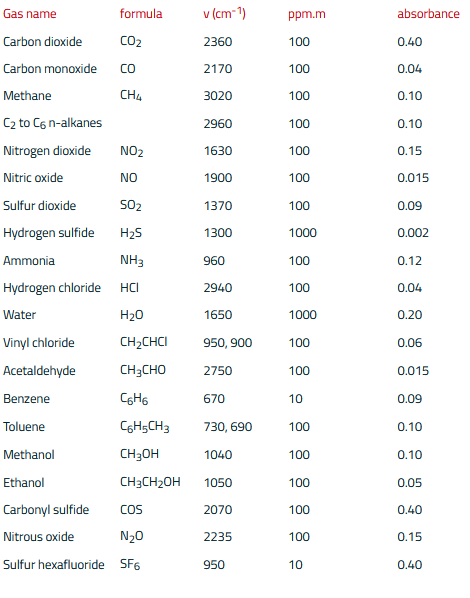
Which pathlength should I choose? The absorbance of a gas depends on the distance travelled by the IR light beam through the gas sample. The relationship between absorbance, A, concentration, C, and pathlength, L, is given by Beer’s Law: A = -log10 (I/I0) = a.C.L Atmospheric concentrations of gases are usually expressed in C.L units of ppm.m – the number of molecules that would be encountered by the infrared beam across a 1.0 m path. A gas at 0.1 ppm atmospheric concentration will absorb as much IR light over a pathlength of 100 m as would the same gas at 1 ppm over 10 meters or at 10 ppm over 1 meter. Accordingly, the pathlength of cell should be chosen to give absorbance values within the spectrometer’s linear range for a given concentration. The following table may be taken as a guide: