

- Home
- Companies
- Microdrones GmbH
- Products
- Microdrones - Model md4-3000 - Heavy ...
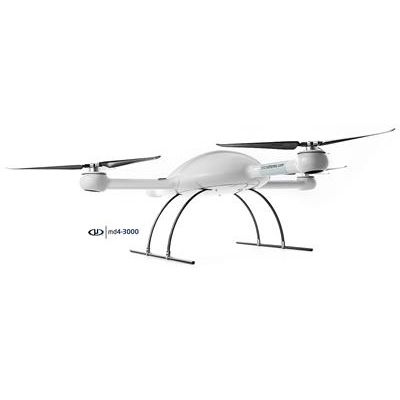
Microdrones - Model md4-3000 -Heavy Lifting Drone
Professionals who need a UAV that works harder should consider the md4-3000, the Microdrones aircraft that can carry more, fly longer, and reach higher. The md4-3000 is our largest aircraft. It can handle heavy LiDAR sensors, professional mapping grade cameras, multiple sensors, and more. If you’re looking for a UAV that allows you to go above and beyond, md4-3000 is the strongest choice in the industry.
We’re an international company, but we’ve stayed close to our German roots, meticulously engineering our components in Germany, with a focus on quality first. Here’s what our design and engineering means for you.
mdFNCThe mdFNC on-board electronics ensure every situation is under control – more precisely than ever before.
Is a function missing? No problem!
The proven technology of the mdBlackBox allows access to all flight data.
mdCockpit is an application which brings together all functions for planning, monitoring and analysing your flights.
The mdIMU is based on new Six Axis sensor, which features even greater precision and higher temperature resistance.
The high-performance RTOS "mdOS" has been optimised for minimum RAM and ROM consumption, as well as high speed and versatility.
The Microdrones System-Integrator-Interface is conceived primarily as a gateway for "intelligent loads".
A flight planning module to prepare and carry out automated flights with your aircraft.
Execute automatic final approach landing. Conduct waypoint missions and land with minimal operator intervention.
mdRFID is the wireless key for your microdrone.
Below are just a few of the benefits of choosing an md4-3000 UAV:icon payload weight
Carry heavier payloads.
md4-3000 boasts an impressive payload capacity up to 11 lbs (about 5,000 g).
Extra-long flight times.
Improve on-the-job efficiency by staying in the air for up to 45 minutes, depending on payload.icon cover more ground
Cover more ground in less time,
thanks to a large sensor payload capacity and footprint.icon high altitude
Fly at high altitudes.
md4-3000 maintains its strong performance at high altitudes. It can fly to heights up to 4,000 m (or 2.5 mi). icon stable flight wind resistant
Fly in harsh weather conditions.
Tough and rugged, md4-3000 can fly (and maintain stability) in wind, rain, and snow.
icon Microdrones direct georeferencing DG solution
Available with direct georeferencing (DG).
Far superior to RTK or PPK, this technology provides significant cost savings to users and enables access when images must be georeferenced in challenging locations. DG enables corridor mapping.
- Rate of climb: 10 m/s
- Operating speed: 20 m/s
- Maximum thrust: 280 N
- Weight: ca. 6,000 g (depending on configuration)
- Recommended load: 3,000 g
- Maximum load: 5,000 g
- Maximum take-off weight (MTOW): 16,000 g
- Dimensions: 2,052 mm x 1,888 mm (from rotor hub to rotor hub)
- Flying time: up to 45 minutes (depending on load / wind / battery)
- Battery: 10S1P LiPo, 37.0 V, 21000mAh
- Flat core motors: yes
- CFD optimised propeller: yes
- Closed carbon housing: yes
- IP43 protection: yes
- Temperature: -10 °C up to 50 °C
- Humidity: max 90% r.H.
- Wind susceptibility: vibration-free images up to 6 m/s
- Flight range: min. 500 m with remote control, with WP up to 50 km
- Service ceiling: 4,000 m ASL
- Take-off altitude: up to 4,000 m NN (WGS84)
- Up to 45 minutes flying time
- Rain-resistant, dust-resistant
- Extremely resistant to cold
- Extremely resistant to heat
- Flat core motors
- CFD-optimised propeller
- Closed carbon housing
- Operation via GPS in combination with Microdrones’ comprehensive software
- Easy to learn, easy to fly
- Low maintenance costs
- Low service costs
- Lower costs compared to traditional manned aircraft
- Low noise electric motor
- Lower air turbulence