


- Home
- Companies
- Kore Technology Limited
- Products
- Kore - Model HR EI-TOF-MS - High Mass ...
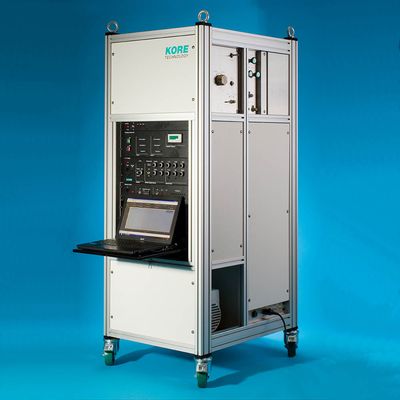
Kore - Model HR EI-TOF-MS -High Mass Resolution Electron Ionisation
The Kore high mass resolution electron ionisation time-of-flight mass analyser (HR EI-TOF-MS) is designed for analysis of process gases for production and research applications. The HR EI-TOF-MS’s ability to quantitatively analyse inorganic gases as well as identify and analyse volatile organic compounds (VOCs) at pressures from millibar to 10 bar makes the equipment well suited to process monitoring as well as catalysis studies and combustion or pyrolysis reaction research. The 19 inch rack-mounted instrument has anti-vibration suspension for easy and safe transportation between different sites.
Electron ionisation (EI) is one of the first and most widely used ionisation techniques in mass spectrometry and has been in use for over 100 years. The ionisation of analyte molecule relies on a beam of (usually) 70eV electrons removing an electron from the molecule during the collision. EI is described as hard ionisation; the excess energy in the collision produces many fragment ions. The ‘fingerprints’ or patterns of molecular and fragment ions can be related to extensive databases such as NIST and allow for mass spectral deconvolution. EI ionisation is most commonly used for ionisation of VOCs and SVOCs.
ANALYTICAL MODES
The TOF-MS system used offers real-time, high time resolution, high sensitivity detection of all gas species in parallel. All masses are collected, preserving the maximum amount of information.
GAS INLET SYSTEM
The instrument is fitted with a dual inlet system comprising a heated capillary inlet for the inorganic gases and a permeable membrane concentrator inlet assembly for the VOCs. The inlet system and capillary is heated to prevent moisture and other low temperature condensates separating from the gas phase before reaching the ion source.
Membrane assemblies provide long-life, low maintenance, rugged concentrating sample inlets that allows lower detection limits to be achieved for many VOC compounds.
MASS SPECTRA
The instrument will generate a single mass spectrum from less than 0.5 seconds to many minutes’ duration if required. Rapid spectral acquisition is key for verifying the correct operation of the instrument, and for deciding how to proceed further with the experiment of interest.
HIGH TIME RESOLUTION MODE
A ‘chromatogram’ mode in which data is typically acquired over periods of up to a several minutes. The data is streamed to disc for this period, and the data can be inspected retrospectively, looking at time intervals of as little as 100ms in the chromatogram direction.
PROCESS MONITOR MODE
The process monitor mode is more suited to long-term monitoring over hours or days. For the live display, the user views an updating plot of up to 16 species that have been selected beforehand. Spectra for each measurement are saved to disk, and the user can go back to the data to plot any species retrospectively.
THE DATA SYSTEM
Data is displayed on a PC, using the Windows® based GRAMS/AI™ software from Thermo Scientific. This industry standard software has been customised by Kore to make the collection of spectra a simple click of a button. The software allows the user to monitor trends in multiple gases over long periods of time.
- Mass range: Unlimited, in practice 1-1000 m/z (limited by gas phase thermochemistry)
- Mass resolution: ≥ 6,000 m/δm (FWHM)
- Response time: ~100ms
- Sensitivity: Xenon in ambient air: 90ppb in 1 minute
- Mass accuracy: 1 milli amu (interpolated), 2 milli amu (extrapolated)
- Inlet system: Dual capillary and membrane to 10 bar pressure gas inlet
- Dynamic range: Better than 6 decades
- Linearity: Better than 1%
- Reproducibility: Better than 0.02%
- Inlet heater: Up to 150°C
- Power supply: 220-240 volts, 1kW
- Dimensions: 61x165x80cm
- Weight: 250kg
- Data acquisition: Rack-mounted PC or laptop
APPLICATION AREAS
- Process monitoring
- Catalysis studies
- Combustion or pyrolysis reaction research
- VOC monitoring (ambient air, product quality control and testing)
- Clean room air quality monitoring
- Breath analysis
- Food analysis
- Homeland security
- Odour identification (buildings, factories etc)
- Fence line monitoring