
Romag - Model RSU -High-Performance CSO Screen
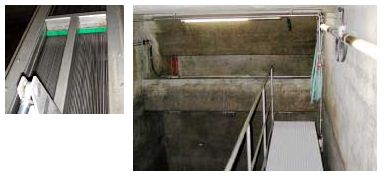
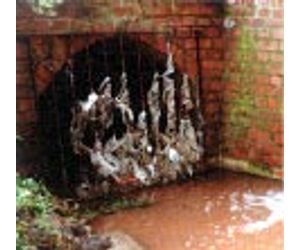
Such pictures are a thing of the past thanks to the use of the ROMAG high-performance CSO screen RSU. Zürich-Wollishofen sewage treatment plant, right basin half with caught material shaft in the background. The ROMAG CSO screen RSU is fitted behind the concrete sill.
of the ROMAG high-performance CSO screen RSU:
- Dispenses with the need to make high investments in retaining capacity volume
- Prevents unnecessary contamination of the receiving water courses
- Is safe and reliable to operate
- Permanently performs mechanical cleaning action
- Is resistant to corrosion
- Is rugged
- Requires little maintenance
- Has a small bar spacing (4 mm)
- Transports the caught material from the inlet zone
- Materials either 316L or 304L
Water flows vertically from bottom to top through the screen which is mounted on the owner‘s prepared concrete sills. The height of the CSO screen depends on the hydraulic survey and is lower than the required water level when relief operations start. The anticipated flow rate is dependent on the resultant retention height and the weir height selected on the basis of conditions. The water is discharged via the concrete sill (emergency relief) if the cleaning system fails (e.g. in the event of electrical power failure) or if overloaded.
Particular importance has been attached to operating safety and reliability. The first step towards this relates to omission of components susceptible to failure such as limit switches. In addition, the electrical and hydraulic control elements are arranged outside the critical zone so that only two hydraulic pipes lead into the wet chamber. The clever design means that the CSO screen cleans itself constantly. There is no cross-bracing which could lead to build-up of caught material in the screen area at the inlet end. In the event of solid material causing brief clogging, the control system is designed to repeat the comb movement at this point until the rake is unobstructed again.
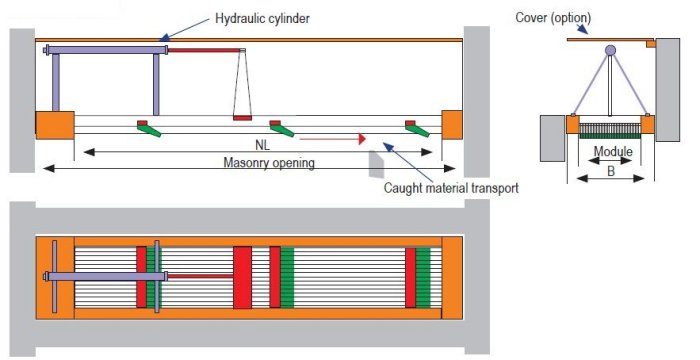
On this ROMAG concept, the caught material is disposed of from the rake area into a caught material shaft (illustration at far left) and guided near to the bottom. This means that the caught material is no longer floated onto the screen surface, which is important when heavily loaded.
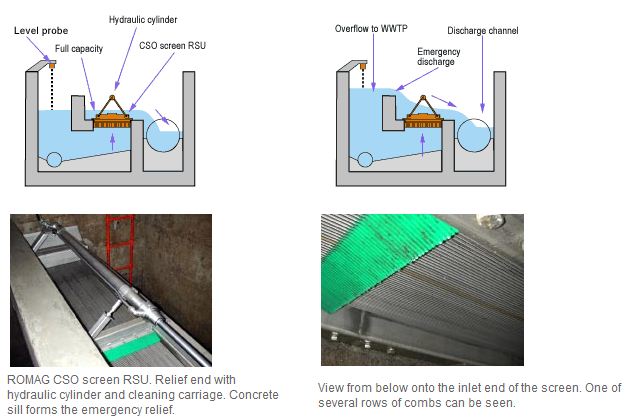
The ROMAG CSO screen RSU consists of a rugged frame made of stainless steel sections. The horizontal rake bars are braced in this frame. The cleaning carriage which is moved to and fro by a double-acting hydraulic cylinder is located on the upper side. Several comb rows of asymmetrical triangular shape move through between the rake bars. The water flowing through forces the caught material against the bars where it is moved on by the cleaning combs with their „steep end“ in longitudinal direction. The flow direction assists this movement. During return travel, the „flat end“ of the combs slides through beneath the caught material. The traverse paths and shapes of the combs are intermatched so that each cleaning comb transfers the caught material to the next cleaning comb. It is slid to the end of the rake and is then discharged with the outflowing effluent to the sewage treatment plant.
This prevents a problematic concentration of caught material at the inlet end.
The CSO screen RSU has proven successful in many applications. However, close cooperation with the offices and agencies involved is necessary in order to achieve a reliably operating installation. This is necessary in order to determine and comply with the hydraulic boundary conditions.
This relates to streamlined feed to the CSO screen and discharge to the sewage treatment plant with the required downgrade: System planning
The caught material which is transported by the rake to a defined point must move continuously downwards into the discharge to the sewage treatment plant. One good solution is to use a caught material shaft.
Particular attention must be paid to the space conditions in the inlet area. Excessively constrained inlet sections aggravate or render impossible the inspection and maintenance work which is required periodically.