


- Home
- Companies
- Kore Technology Limited
- Products
- Kore SurfaceSeer - Model S TOF-SIMS - ...
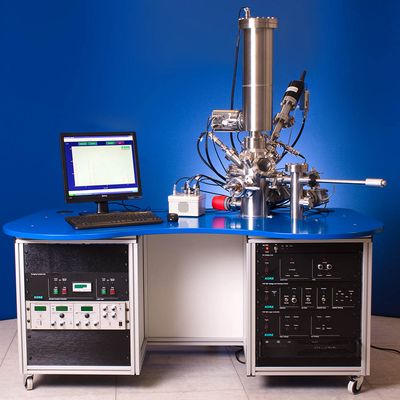
Kore SurfaceSeer - Model S TOF-SIMS -High Sensitivity Surface Analysis
Understanding surface chemistry is no longer limited to university research labs, but is now increasingly important to many areas of mass-production; even a simple crisp packet is a highly engineered material system with multiple layers having different functions. Surface science instruments have typically been very expensive and require knowledgeable staff to operate them and interpret the data. This meant acquisition of surface science instruments in industry has been mainly confined to the large central research labs of major companies.
Kore are delighted to present a solution: an affordable and compact system for fast surface chemical characterisation, the SurfaceSeer S. The SurfaceSeer S is designed to be an affordable workhorse of the TOF-SIMS range. It is ideal for investigating the chemical composition of sample surfaces and is equally at home in R&D or industrial quality control applications.
The instrument uses a 5keV Cs+ ion beam (optionally inert gas Ar+) that is pulsed to minimise the surface damage that would otherwise be caused by a continuous ion beam. The gun pulses on for only 60ns in every 100µs TOF cycle, and thus the primary beam delivers more than 1,000 times less current than if it were on continuously. A typical experiment time of 10s delivers a dose equivalent to only a few milliseconds of continuous beam current. Several minutes of analysis in a single spot would be required to reach the so called “Static SIMS” limit, the point at which surface damage becomes clearly visible in the data (focus and beam-current dependent). Despite the low ion doses, the TOF analyser is very efficient, and this accounts for the high secondary ion data rates (typically 5000 c/s even on relatively low ion yield polymers).
Where required, the primary ion current can be increased and the ion gun turned on continuously and rastered for sputter cleaning of suitable samples.
DELAYED EXTRACTIONThe instrument also employs a technique known as ‘delayed extraction’ for the secondary ions produced. In this technique the primary ions bombard the surface and produce the analytically important secondary ions. A short time after the primary beam pulse has finished bombarding the sample, the ion extraction field is pulsed on. This results not only in secondary ion extraction, but also secondary ion compression as the ions travel through the analyser to the detector. In some TOF-SIMS instruments the primary beam is compressed or ‘bunched’, but in this instrument it is the secondary ions that are bunched. This delayed extraction is set so that the secondary ions of the same m/z are temporally focused to produce better mass resolution than would otherwise be obtained with the long primary pulse (60ns) on its own.
CHARGE NEUTRALISATION
One of the advantages of using a pulsing ion beam/delayed extraction combination is that there are relatively long periods in each TOF cycle when there is no ion extraction field applied. In that period a pulse of low energy electrons (30eV) is directed at the analytical area. By doing this it is possible to neutralise the effect of positive charge that would otherwise build up on the surface as the primary ion beam bombards an insulating sample.
TOF ANALYSER
The instrument has a 150mm diameter reflectron analyser, with a total effective flight-length (including the flight tube) of 2 metres. It is a dual-slope reflectron with in-vacuo high precision resistors, and has an adjustable ‘retard’ potential within the reflectron that has been set for optimum spectral performance.
VACUUM PUMPING
The instrument has a single rack-mounted vacuum controller that controls the vacuum system. Turbomolecular pumps are used to maintain vacuum in the analytical chamber and the sample load lock, each of which is backed by a 2-stage rotary pump. Load lock venting and pumping is achieved with a single manual button on the vacuum controller. A high vacuum gauge (inverted magnetron) monitors the pressure in the analytical chamber at all times, and is used to provide vacuum interlock protection, shutting down high voltages if the pressure rises beyond a set point.
- High Surface Sensitivity: 1x10⁹ atoms/cm2 (ppm)
- Mass resolution: >2,500 m/δm (FWHM)
- Mass range: >1000 amu
- Mass range to 10,000 amu with high mass detector (option)
- Mass Accuracy: ± 5 milli amu
- Analysis Area: 100µm to 1000µm
- SIMS: Positive and Negative Modes
- Low energy electron gun for charge compensation of insulators
- Elemental and Molecular Information from Surfaces
- Isotopic Analysis
- Conducting and Insulating sample analysis
- Sputter Cleaning capability
- 1 minute analysis
- 5 minute sample pump down from atmosphere
- SIMS data libraries available
- Optional optical microscope / camera / monitor
APPLICATION AREAS
Owing to its surface sensitivity of just a few atom layers, the ‘S’ allows studies of materials in the areas of:
- Surface chemistry
- Adhesion
- Delamination
- Printability
- Surface modification
- Plasma treatment
- Surface contamination
- Trace analysis (ppm in surfaces)
- Catalysis
- Isotopic analysis
APPLICATION NOTES