


- Home
- Companies
- QUA Group LLC
- Products
- QUA Q-SEP - Hollow Fiber ...
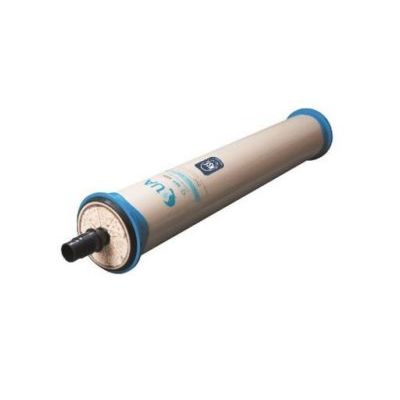
QUA Q-SEP - Hollow Fiber Ultrafiltration Membranes
Ultrafiltration (UF) is a membrane process used to remove suspended solids, colloidal matter, high molecular-weight substances, and bacteria and viruses from various feed water sources. UF membranes can achieve a low and consistent silt density index (SDI) and are often used as pretreatment for reverse osmosis using surface water, seawater and biologically treated wastewater as feed source. QUA Q-SEP® UF membranes incorporate high-strength, hollow fibers that deliver superior performance without the risk of fiber breaks. Q-SEP® UF membranes are available in inside-out and outside-in flow configuration. Both types of membranes have excellent low fouling characteristics. These hollow fiber membranes operate under a pressurized flow configuration for superior performance.
Q-SEP UF fibers and modules are manufactured in a state-of-the-art, environmentally controlled manufacturing facility. In the facility, continuous online monitoring to maintain consistent quality. Turbidity can be reduced to less than 0.05 NTU. Typically, a 6-log removal for bacteria, giardia and cryptosporidium, while a 4-log removal for viruses, can be achieved.
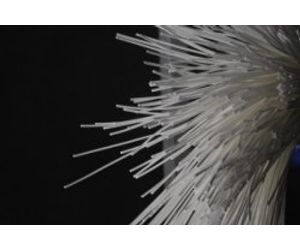
Q-SEP modules contain an advanced UF fiber prepared by an innovative patented cloud point precipitation method. This method ensures a very uniform pore size distribution and high pore density in the membrane. As a result, the product water quality from the Q-SEP modules is significantly better than the quality from conventional UF modules at a very low operating pressure.
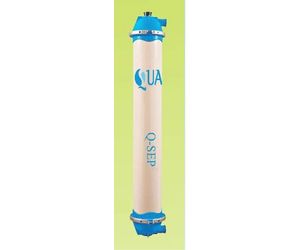
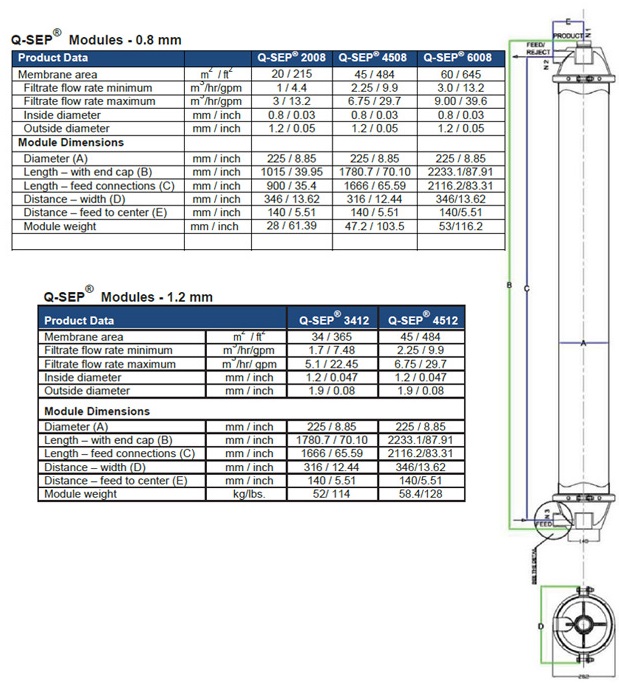
The fibers in the Q-SEP module are held firmly in place, which reduces the stress on the fibers even at high flow velocities. Uniform fiber packing limits the pressure drop variation within the module and prevents localized high fouling conditions. The unique end cap sealing design allows for high pressure operation and ease of assembly. The UF modules can be used as dead-end filtration or in cross flow mode. The membranes are available with 0.8 mm ID fibers, suitable for feed water with low turbidity and 1.2 mm ID fibers, suitable to treat water with higher turbidity.
What NSF-PDWEP Certification says about Q-SEP membranes?
NSF has certified the Q-SEP 2008, Q-SEP 4508, Q-SEP 6008, Q-SEP 3412 and Q-SEP 4512 UF modules for Cryptosporidium removal efficiency, using Bacillus endospores as a surrogate following the USEPA Long Term 2 Enhanced Surface Water Treatment Rule product-specific challenge testing framework meets with all applicable requirements of NSF/ ANSI 419. The Qua Group LLC uses a pressure decay test as their manufacturing NDPT for the Q-SEP modules.
Features/Benefits
- Patented Cloud Point Precipitation Process
- High Porosity
- Lower Cleaning frequency
- Better Mechanical Integrity
Value to Customer
Higher Quality Filtration
Unique manufacturing process results in uniform pore size distribution on membrane surface resulting in consistently lower filtrate SDI.
Lower Capex or Lower Opex
Can be operated at higher flux or lower TMP.
Better Availability
QSEP has superior fouling resistance properties.
Reliability
QSEP has superior product design and mechanical integrity of components.
- The Q-SEP UF Features
- Superior module design
- Consistent pore sizes
- Uniform membrane fibers
- High porosity along the entire length of fiber
- Quality checks to ensure integrity of individual fibers prior to module assembly
Advantages of the Q-SEP UF over Conventional Media Filtration
- Improved filtrate quality
- SDI typically less than 1
- Removal of virus and bacteria
- Removal of microbiological matter
- Removal of colloidal matter
- No need to add coagulant chemicals for most applications
- Improvement of downstream RO performance
- Consistently treated water quality irrespective of changes in feedwater quality
Applications of the Q-SEP UF technology
- Pre-treatment to reverse osmosis system (brackish and seawater applications)
- Purification of surface and well water for potable applications
- Filtration of industrial water
- Wastewater recycle and reuse
Certifications
- NSF ANSI 61
- NSF PDWEP (EPA LT2ESWTR)
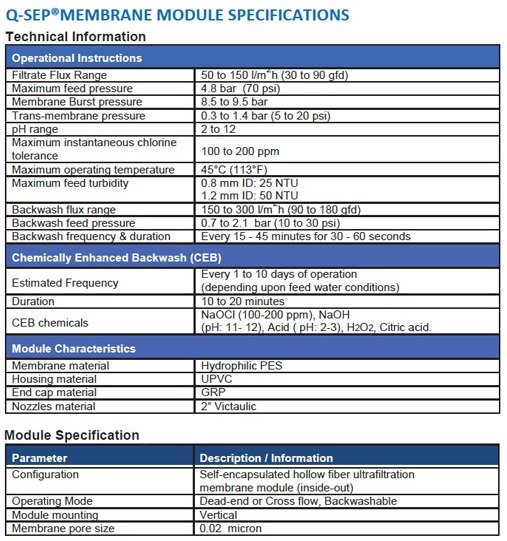
Parameter: Description / Information
- Configuration: Self encapsulated hollow fiber ultrafiltration membrane module (inside-out)
- Operating Mode: Dead-end or Cross flow, Backwashable
- Module mounting: Vertical
- Nominal Membrane pore size: 0.02 micron
- Advantages of the Q-SEP UF over Conventional Media Filtration
- Improved filtrate quality
- SDI typically less than 1
- Removal of virus and bacteria
- Removal of microbiological matter
- Removal of colloidal matter
- No need to add coagulant chemicals for most applications
- Improvement of downstream RO performance
- Consistently treated water quality irrespective of changes in feed water quality
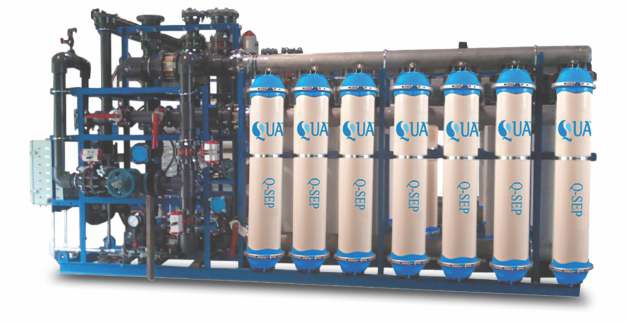
- Reverse Osmosis System Pretreatment
- Brackish Reverse Osmosis Pretreatment
- Seawater Reverse Osmosis Pretreatment
- Drinking Water from Well Water
- Drinking Water from Surface Water
- Industrial Water Filtration
- Water Recycling
- Water Reuse