


IAC - Bulk Loading, Unloading and Bagging
During the bulk loading of product, dust contained within the product can be liberated and emitted into the ambient air as the product falls from the loadout area to the transport container (truck, rail car, barge, or ship). This dust-laden air can expose workers to respirable dust, as well as create nuisance dust problems. A number of factors impact the severity of dust liberation during bulk loading, including: the type of product and its size distribution, moisture content of the product, volume of the product being loaded and the loading rate, the falling distance, environmental factors such as wind velocity and rain, and physical characteristics of the receiving vessel.
The loading spout is designed to transfer product from a plant/storage container into the vehicle that will be used to transport the product. Typically, these spouts have the capability to extend down to the vehicle being loaded and then be retracted to allow the vehicle to move away from the loading station. Spout travel can be as little as a few feet and can extend up to 100 feet. Telescoping loading spouts are equipped with a series of telescoping cups or pipes that extend and retract. The spout typically has an outer shroud which encases the product transfer section of the spout. This outer shroud shields the product from the elements (rain, wind, etc.) and helps to contain any dust that is liberated.
The loading of product into some type of container is normally called “bagging”. The stacking of these bags of product onto pallets for shipment to customers is typically called “palletizing”. There is a wide spectrum of different types of bags that are used to ship product to customers, ranging from 50-pound to over one-ton bulk bags. Only the smaller type bags (100 pounds or less) are typically palletized because the larger bulk bags are in most cases, individually shipped. Both the bagging and palletizing process can be performed manually or through some type of semi-automated or totally automated process.
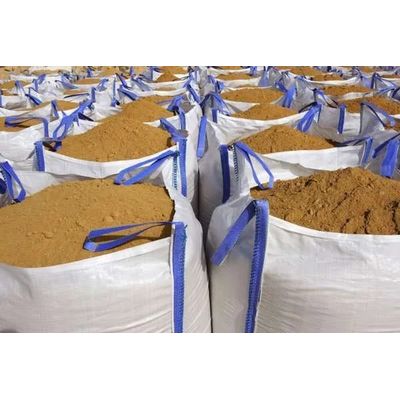
Flexible Intermediate Bulk Containers (FIBCs), also called “bulk bags”, “semi-bulk bags”, “mini-bulk bags”, and “big bags”, have become more popular over the recent years for shipment of product material. They are often more cost-effective than the 50-, 80-, or 100-pound bags for both the producer and the end user.
The most effective method to control the dust liberated during filling of FIBCs is by using an expandable neoprene rubber bladder in the fill spout of the bagging unit. This bladder expands against the interior of the FIBC loading spout and completely seals it, eliminating any product and dust escaping from the spout during loading. When using this expansion bladder, the feed spout must also incorporate an exhaust ventilation system to exhaust the excess pressure from the FIBC during loading.