

- Home
- Companies
- Aquatic Research Instruments (ARI)
- Products
- Aquatic-Research - Icelandic Piston ...
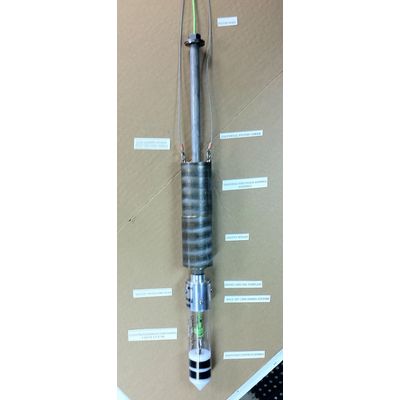
Aquatic-Research - Icelandic Piston Corer
Paleoecological analysis. Lightweight piston sampler for soft lake deposits. Long (2.0m long/drive), undisturbed cores of sediment- water interface from shallow lakes. Ideal sampler for gyttja, clay, and fine sand sediments.
ICELANDIC PISTON CORER
- Collects best quality core samples
- Piston sampler can be deployed on Aluminum Holobar Extension Rods (to max depth of 25 meters) or in deep lake with Cable Deployed Percussion hammer Assembly (see both options below)
- 68 mmid x 71 mmod aluminum and stainless steel construction
- Bolt on barrel attachment method
- Drives clear polycarbonate core barrel x (2 5/8" (68mm) x 2 3/4" (71mm)
- 10 m piston wire w/ attachment hardware
- Three (3) adjustable piston assemblies w/ "o" rings
- Ready to deploy
ALUMINUM HOLOBAR EXTENSION RODS
- 40 mm diameter aircraft aluminum holobar construction
- 7/8”- 9NC stainless steel threaded couplers, wrench flats (to aid uncoupling), lightweight, rigid and buoyant
- Available in two (2) lengths: 1.2 m and 2.4 m
POLYCARBONATE CORE BARRELS
- Proven to produce the best quality samples with minimum amount of sample loss, 2 5/8” (68mmid) x 2 3/4” (71mmod) thin walled barrels with chamfered (sharpened) ends, poly end caps, core extruding plugs (optional)
- Available in standard lengths of: 60 cm, 1.2 m, and 2.4 m
DEEP WATER CABLE DEPLOYED SLIDE-HAMMER ASSEMBLY
- For Icelandic piston corer in deep lakes (greater than 25 meters)
- Piston wire travels “dead center” through stainless steel tube (100 cm long) that supports gravity weight and slide hammer assembly and attaches to adjustable piston assembly at distal end of wire.
- Sampler is lowered by a two (2) point bridle on slide hammer assembly while piston wire remains slack during deployment.
- Once mud water interface is reached; secure piston wire to decking to prevent downward movement of piston; release lowering line to allow gravity to begin coring action.
- Raise and drop slide hammer assembly to drive core barrel to desired stratum.
- Retrieve sampler to surface by hauling upward on both lowering line and piston cable
- 90 cm long x 8 kg SS tubing (piston cable runs (plumb) through tubing)
- One (1) each bronze gravity weight
- One (1) each bronze slide hammer assembly w/ 2-pt bridle (to lower sampler)
DISCRETE POINT PISTON SEDIMENT SAMPLER
- Polyethylene, polycarbonate and stainless steel construction
- 10 m piston cable
- adjustable piston assembly
- 1.5m built-in extension/extruding rod w/key
- rubber coupler sleeve
- one-ea. Thin-walled clear polycarbonate core barrel (68 mm x 71 mm x 120 cm)
- core extruding plug
- poly end caps
- spares
- carry case
- hexdriver
- 2-ea aluminum holobar extension rods w/ stainless steel couplers (40mm diam. x 2.4m)
- Clear polycarbonate core barrel with poly end caps: 68 mm x 71 mm x 240 cm
- Clear polycarbonate core barrel with poly end caps: 68 mm x 71 mm x 120 cm
- Aluminum holobar extension rod w/ stainless steel couplers (40mm diam. x 2.4m)
- Aluminum Holobar extension rod w/ stainless steel couplers (40mm diam. x 1.2m)
Notes: The piston assembly and thin wall core barrels collect, high quality, uncompressed samples. Upon retrieval, one must plug the bottom of the core tube before breaking the air-water interface (with core extruding plug or poly end cap) to prevent loss of sample.
Clear polycarbonate core barrel material readily available at most plastic distributors. Core extruding plugs allow one to incrementally extrude sediments upward with aid of a Core Extruding Apparatus. Core barrels can easily be drilled/plugged (for pore water extraction), serrated, cut and split to meet the special needs of the investigation.
- rinse polycarbonate core tube and piston assembly with water
- loosen piston assembly and insert in core tube with cable attached
- slide core tube on to core head and tighten hose clamps on "no-hub coupler"
- use drive/extrusion rod to push piston assembly to the lower end of core tube and tighten piston assembly (tight enough to be difficult to move by hand) in core tube with the key on end of extrusion rod
- retract drive/extrusion rod and secure in place with retainer pin
- determine the depth of water and couple the necessary extension rods together
- lower the corer to just above the sediment-water interface with slack in the wire. (Figure 1, A)
- tie the piston wire to the coring platform.
- drivers should place their hands at various levels along the drive rod so that the push can be steady for a full meter without pause
- (note: a pause during a drive may prevent furthur recovery since internal core friction may cause plug formation and core compaction)
- if driving becomes difficult, it may be nessasry to use pipe wrenches or cross beams to provide mechanical advantages (Figure 1, B)
- pull the corer from the sediments while maintaining tension on the piston cable (if cable slips, part of the core may be lost) (Figure 1, C)
- cap the bottom of the core tube with polyethylene caps (or bottom piston when extruding from the "bottom-up") until the extrusion process begins.
Fisher, M.M., M. Brenner, K.E. Reddy., 1992. A simple, inexpensive piston corer for collecting undisturbed sediment/water interface profiles., Journal of Paleolimnology, 7:157-161. Wright, H.E., 1991. Coring tips., Journal of Paleolimnology, 6:37-49. Blomqvist, S., 1991. Quantitative sampling of soft bottom sediments: problems and solutions., Mar. Ecol. Prog. Ser., 72: 295-304. Wright, H.E., 1980. Cores of soft lake sediments., Boreas, 9:107-114. Wright, H.E., 1967. A square drive piston sampler for lake sediments., J. Sedim. Petrol., 37:975-976. Cushing, E.J. and W.E. Wright., 1965. Hand operated piston corers for lake sediments., Ecology, 46:3:380-384.