


- Home
- Companies
- Prodev Mühendislik Makina Sanayi ...
- Products
- Proscreen - Model I1030 - Inclined ...
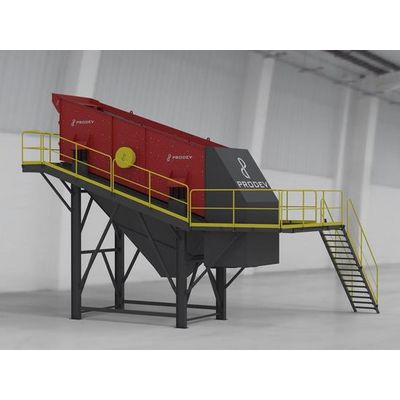
Proscreen - Model I1030 -Inclined Screen
Inclined screens are very important for all mineral processes. The process of grouping the bulk material containing pieces of different sizes in at least two size ranges is called screening. The screening process is referred to as the "classification process" in mineral processes. Screening panels with specific sizes of mesh are attached to the screen body. While the fed material moves on the screen panel with the vibration of the body, the pieces smaller than the mesh gap pass to a lower screen panel with a smaller mesh size to be screened again.
What is Screening?
The basic usage of all vibrating screen is the same. The parts smaller than the mesh opening of the screen panel can pass under the screen panel, and these parts are called under-screen materials, and the materials larger than the mesh opening go towards the front chute before they can pass through the screen panel. These materials are called screened material. The screening efficiency increases as the particles pass through the mesh opening.
Inclined screens are generally manufactured as 2, 3 or 4 layers. On each deck, there are structures with herringbone geometry, called screen frames, and carries the screen panel. If the material is small enough to pass through the eye gap in the deck it is in, it passes to a lower deck, otherwise it passes from the end of the deck to the front chute. A chute at the pouring point of the screen transmits the over screen material from each layer to the next stage without mixing them.
Since inclined screens are very preferred in crushing and screening processes, they are referred to as standard type. Standard type Vibrating Screens and Horizontal Vibrating Screens are equipment of the classification stage, which is the final process of the crushing and screening plant. It enables the crushed materials to be separated according to their sizes and sent to different stock areas.
Therefore, vibrating screens are the determinant of performance at all stages of the process. In other words, the higher the screen performance, the more successful the efficiency, the more successful the plant`s efficiency, the higher its performance.
Inclined screens are the most used equipment for the classification process. It consists of screen body, drive mechanism and elastic system. The body houses the drive mechanism and screening panels.
Screening panels are tautly connected to structures called screen frames. The screen frames are designed to give the panels a herringbone shape. The frames also provide the rigidity of the body.
The drive mechanism is the most important part of the screen. The centrifugal force created by the rotation of the eccentric weights connected to the two ends of the screen shaft at a certain speed ensures that the screen body makes a continuous reciprocating motion on the elastic system. Thanks to this oscillating movement, that is, the vibration movement, the material is provided to move on the panel.
It is very important that the screen panels are mounted on the body correctly.
* While the screen is operating, there should not be any blockage in the panel chambers.
* At least 95% of the parts smaller than the eye size of the panel must pass to a lower level. This ratio is expressed as screening efficiency and the remaining 5% is called fugitive material.
*Due to the transmission speed of the screen, there should not be any accumulation on the panel.
G Force is called the acceleration given by the screen body to the material to be screened. The value of the G Force is expressed as a multiple of the gravitational acceleration (g=9.81 m/s²).
G force is calculated with the formula
"G = w²*(S/2)/g". Here
w: Angular Velocity (1/sec) [w=π*n/30]
S: Stroke (meters)
g: Gravitational Acceleration 9.81 (m/s²)
The recommended G range for inclined screens 3-4G range has been proven by experience so far. If the G value is lower than the recommended range, it may cause a decrease in screening efficiency and capacity, and clogging of the screen panels. If it is more than this range, it may cause the drive part to be forced, cracks in the screen body, and shorten the bearing life.
Thanks to the vibration mechanism that ensures the uniform spread of the fed material, the material accelerates on the screen surface and the fine material is easily screened.
Thus, while the productivity is kept at the highest level, the vibrating screen performs at full capacity.
In screen capacity, the quality of screening panels, the main element of screening, is also very important. We recommend using the screen equipment recommended by PRODEV.
When screen panel replacement is required, the front chute is opened within minutes with the rail mechanism it has.
You will not waste time, thanks to the grease nipple that we extend outside the housing, without having to remove the belt and weight guards for lubricating the bearings.
- Size 1000x3000mm
- Deck 2
- Motor Power 5,5 kW