

- Home
- Companies
- Mion Costruzioni Meccaniche SRL
- Products
- MION - Model 3.0 - Intake and Aerosol ...
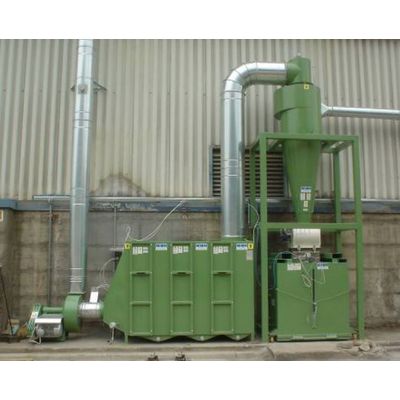
MION - Model 3.0 -Intake and Aerosol Removal Machine
The lubrication and cooling of the tools mounted on the machines is generally done through the use of oil in water emulsion and/or stabbing, whose pouring on the moving bodies induces the formation of aerosols, which tend to spread rapidly in surrounding areas. The resulting pollution of the workplace means, if the contamination is hygienically relevant, the need for environmental remediation, carried out by the appropriate local exhaust ventilation systems, which provide for the collection of fumes and aerosols and their forced conveyance to outer atmosphere.
Compliance with the limits prescribed often requires the installation of a treatment system that is sized according to the stream of the gas flow, in order to provide adequate cleaning of the aspired gas. The sewage treatment plant recommended by our Company is of the dry type, consisting of a set of washable and interchangeable panels that are mounted on U-rails arranged in a section of a broken line and are composed of a cage with two external screens for containment of a filling made from aluminum or stainless steel AISI 304 wool The panels are arranged in series of multiple columns and, for double effect of coalescence and labyrinth, provide the separation of particulates from the gas stream, whose condensates are conveyed to one or more central collection plenum, from which are periodically drained through a tube equipped with a tap-off with manual opening.
Special care is taken, depending on the specific application, in the calculation of the crossing speed of the fumes and the selection of the type of coverage of the panels and the respective number of columns in succession, in order to maximize reduction efficiency and miniminze load pressure. Where fumes present significant quantities of dust depending on the fouling reached, the panels must be removed periodically (usually only those of the first column) and washed with warm water jet pressure.
The choice of an alternative dry treatment system compared to the wet has been made by us according to the following benefits:
- greater guarantee of any kind of reduction of oil aerosols, which, being sometimes difficult to wet and decant, would result, in the wet system and with the same performance, in the use of large volumes of lavage fluids (water and/or aqueous solutions of surfactants).
- Increased operational reliability.
- No need for additional and often expensive treatment and/or disposal of spent cleaning solutions.
- Possibility of recovery of the compounds separated and drained from the collection plenum.
- Considerably lower load waste, resulting in significant energy savings of the
- Lower volumes of space.