- Home
- Companies
- EcoShield Environmental Systems, Inc.
- Products
- Integrated Pre-Treatment Bioreactor
Integrated Pre-Treatment Bioreactor
The EcoClean Integrated Pretreatment BioReactor System is appropriate for a much wider range of contaminates and situations than the ECBR system. Many highly toxic organic compounds including many phenols, chlorinated hydrocarbons, and aromatic compounds can be pretreated first in batches with the IPBR system then switched over to biotreatment in the bioreaction mode using the same IPBR system. Process capacity can be increased by using the IPBR for the pretreatment step only and then using a Companion BioReactor for the final treatment. Clean water and filterable biomass are the final products. In some cases start up pH adjustment followed by periodic manual re-adjustment or automated control of pH will be needed. Automated pH control is available as an option.
Size, configuration options, and accessories
IPBR Systems are currently available in three standard sizes. Actual treatment capacities will vary depending on the concentration of the contaminates. Volumes ranging from 100 to 10,000 gallons can be typically treated in 5 to 20 days. Just mount the IPBR system on a nearby wall near you storage or process tank, hook up the supply and return lines, plug it in and turn on the power switch. Then sit back and let it do all the work.
Major benefits
- Extends cleaning solution life
- Improves and stabilizes cleaning solution performance
- Reduces disposal costs
- Reduces chemical consumption and costs
- Can be integrated into EPA mandated P4 (Permanent Pollution Prevention Plans)
Dollars and sense
With an EcoClean IPBR unit, there is less wastewater to discharge, and what is discharged is much less hazardous. With all that, it still costs less to run than the average home computer, or about $.44 cents per day.
What It Does For Your Waste Water Treatment Woes
The EcoShield IPBR Reactor chemically converts toxic, organic, and oily waste water compounds into biodegradable compounds. Many waste water streams contain compounds that are toxic to biological processes when present in high enough concentrations. In low concentrations these contaminates can pass right through biological treatment systems untreated. These toxic compounds are commonly found in antiseptic hand cleaners, biocides, antibiotics, and various cooling water treatment formulas. Aromatic compounds such as Phenol, Toluene, O, M & P-Xylene, Benzene and Ethyl Benzene are also toxic to biological treatment systems.
The EcoShield IPBR Reactor Systems are designed to catalyticaly convert these toxic compounds into benign, non-toxic, biodegradable compounds in an economical and environmentally sustainable process that is based on EPA`s DFE (Design For Environment) philosophy.
Major Benefits
- Detoxifies waste water prior to biological treatment processes.
- Reduces total waste water treatment system costs.
- Reduces treatment chemical consumption, energy and maintenance costs.
- Reduces sludge disposal liability.
- Traps and chemically converts VOCs and HAPs in waste water into non-volatile, biodegradable compounds without producing greenhouse gas by-products such as CO, CO2, NOx, and SOx.
- Enables water recycling.
How it Works
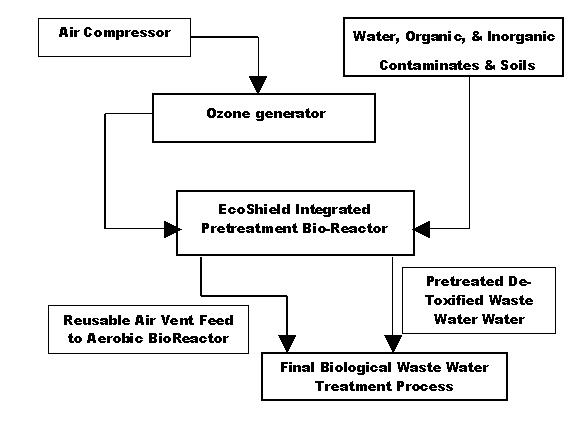
Contaminated waste water is drawn and fed to a miniature internal reactor column. A self contained internal air cooled air compressor and ozone generator feed ozone to the internal reactor column. Ozone reacts with organic contaminates in the gas phase of the reactor.
The reaction process converts bio-toxic, oleophilic, organic contaminates into partially hydrophilic, biodegradable organic compounds. Reaction products continue to react with the remaining contaminates in a catalytic polymerization reaction step which completes the conversion process.
Applications
The EcoShield IPBR System is appropriate for waste water pretreatment to remove toxic organic compounds prior to any biological waste water treatment process. Standard IPBR series units have a maximum liquid input temperature of 120 ° F. An optional upgrade to 140 ° F maximum is available (IPBR-SPW-MT) and operating temperatures up to 200 ° F are also available if needed (IPBR-SPW-HT-SS). Operation at elevated temperatures can be more energy efficient in some applications by utilizing the elevated temperature to accelerate the gas phase catalytic reaction rate of the process thereby reducing the ozone generator size and its associated power requirements.
The IPBR is also designed to operate in a two stage batch mode. In stage one it converts bio-toxic compounds into biodegradable compounds. In stage two the air feed is still operating but the ozone generator is turned off. The stage one detoxified waste water is then seeded with a small amount of a non-pathogenic bacteria and micronutrient package. The waste water is then batch circulated through the bioreactor to supply oxygen to the aerobic bacteria at room temperature. In stage two the IPBR functions as an aerobic bioreactor. You get both processes in the same machine! When a new batch is started up and the ozone feed is restored, the ozone cleans the bioreactor in a self maintenance step that keeps the reactor from getting fouled and plugged with bio-mass. This system has been successfully used on waste water from paint stripping operations that contained Phenol, Toluene, Methylene Chloride and MEA (MEthanolAmine).
Installation Requirements
All that is required to install one of these units is to mount it near the waste water feed tank and near a 110 volt electrical service (it comes with a plug and cord installed but can be hard wired to the conduit fitting that is included on the control panel). There are three bulkhead fittings at the bottom of the units. One of these bulkhead fittings is used for connecting the waste water supply feed to the internal pump. The second fitting is the treated waste water return line connection. The third is an overflow / vent return line. The vent return line can be fed or plumbed to a bioreactor to re-use the remaining pressurized air from the vent to feed oxygen to an aerobic bioreactor. These lines can be plumbed with polyethylene or PTFE tubing, hard plastic pipe or stainless steel tubing at your discretion.
Maintenance Requirements
The system includes its own pump, pressure switch to protect the pump from damage in case of loss of prime, a timer startup circuit for priming the pump, and an interlocking pressure switch to ensure that air and water are flowing before the ozone generator is allowed to power up. Also included are anti-siphon backflow prevention check valves to protect the ozone generator and air compressor. Independent on / off switches with power on indicator lights for the waste water pump and ozone generator are also standard.
Operating Costs
Operating cost is under 3 cents per hour for the IPBR-500.