


- Home
- Companies
- Imspex Diagnostics Ltd.
- Products
- Imspex - Ion Mobility Spectrometry for ...

Imspex - Ion Mobility Spectrometry for Analytical Technology
What is Ion Mobility Spectrometry (IMS)? Ion Mobility Spectrometry (IMS) is an analytical technology that separates analyte mixtures into their component compounds and then detects what these compounds are. Separation of compounds is based on the specific drift times that ionised compounds need to pass a fixed distance (drift tube) in a defined electric field. The drift time of each substance is determined by the mass and geometric structure of its own ions. These parameters determine the number and rate of collisions with the drift tube walls that, in turn, impact upon the speed of transit through the drift tube. An electrometer then measures the resulting ion current as a function of time.
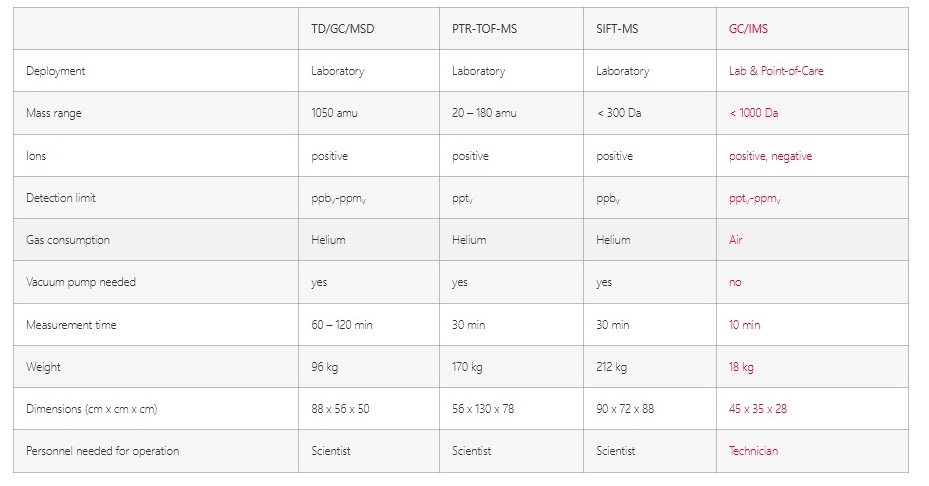
While IMS can be complimentary with many analytical techniques, it can often be seen as an alternative to GC-MS. So, how do they compare?
Performance
- GC-IMS is ideal for detecting variations in known matrices
- Rapidly detects small differences in complex samples
- Faster and more reliable screening than human sensory panels
- As sensitive as standard GC-MS for a wide range of VOCs
- Inherent two-dimensional separation allows fast throughput of complex samples
Low ongoing cost of ownership
- Simplicity of operation means the system just keeps running
- Reproducibility and repeatability mean low frequency of calibration
- Designed to run continuously in the lab or at-site
- Requires only high purity nitrogen as carrier and drift gas
- Can be operated by personnel with non-specialist training
- Uses standard laboratory consumables
- Routine maintenance conducted by end-user
At home, in the laboratory or on-site
- Compact all in one solution (sampling, separation, detection and analysis in one box)
- Easy to transport
- Simple interchange between advanced user or turn-key interface
- Ideal for remote locations
- Can store data locally for interrogation or download, or transmit via a network
- No vacuum pump to maintain
Intuitive software
- Allows simple on-instrument output of results and/or data mining by advanced users
- Makes complex chromatogram comparison easy
The problem to be solved
Early and accurate detection of the presence of a disease in an individual is key to improving outcomes for patients and value for healthcare providers. Breath analysis is one of the technologies emerging from the realms of Big Data and computing advances that holds promise to make early detection of disease a reality. Early identification of metabolic disease processes would be a game changer for more effective treatment and management of infectious diseases, cancers and chronic lifestyles diseases, to name just a few conditions.
A role for Volatile Organic Compounds
Volatile organic compounds (VOCs) in exhaled breath contain large amounts of chemical information that reflect the biological mechanisms and metabolic processes at play within an individual at any given point in time. When analysed into metabolic profiles, this information can be used as a biomarker to detect the presence of disease condition.
Until recently, sufficiently sensitive analytical technology and computing power has not been available to be able to detect, quantify and extract patterns that can be associated with specified disease states from very low concentrations of compound. Imspex Medical’s GC-IMS technology addresses this gap.
Our GC-IMS technology
Our technology combines the analytical chemistry strengths of gas chromatography (GC) and Ion Mobility Spectrometry (IMS) with Big Data multivariate data analysis power. Analytical chemistry results are analysed with proprietary integrated software to identify digital compound signatures and to link these to given target disease indications.
Detection using this ultrasensitive method yields rapid and accurate results, even with low compound concentrations. It is robust and can be used in both centralised laboratories and for decentralised testing. This makes it equally applicable for use in environments ranging from laboratories through to community healthcare and mass screening situations.
Technical characteristics of GC-IMS
Early and accurate detection of the presence of a disease in an individual is key to improving outcomes for patients and value for healthcare providers. Breath analysis is one of the technologies emerging from the realms of Big Data and computing advances that holds promise to make early detection of disease a reality. Early identification of metabolic disease processes would be a game changer for more effective treatment and management of infectious diseases, cancers and chronic lifestyles diseases, to name just a few conditions.