


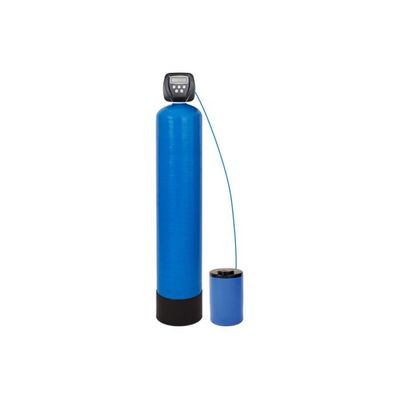
Krilico - Model IR -Iron Removal Filters
Krilico IR iron removal filters are designed to remove iron, manganese, and hydrogen sulfide compounds from water. Often, even water from the deepest underground sources can contain high levels of iron, unpleasant odor, taste, and color. This adversely affects not only human health but also everything that comes into contact with water. Typically, iron in water is present in a dissolved form. To filter out iron, it needs to be oxidized and converted from a dissolved form to an insoluble one. This can be done using oxygen aeration or more powerful chemical oxidants such as potassium permanganate (KMnO4), sodium hypochlorite, etc. The oxidized compounds are then filtered out in the filtering media layer. This is why iron removal filters are divided into reagent-based and non-reagent-based.
The principle of operation of reagent-based iron removal (chemical regeneration of the filtering media):
Water flows through the filtering media layer from top to bottom, comes into contact with the oxidant, and is filtered directly within the thickness of the filtering media. Then, the purified water exits through the central distribution system to the consumer. As oxidized metals accumulate on the filtering media, its resistance increases, resulting in a significant pressure drop. Consequently, the quality of purified water can deteriorate significantly. Therefore, the filter needs to be backwashed (regenerated).
Regeneration is initiated automatically using a multi-way control valve or valve group controlled by an automation cabinet and includes several stages:
- 1st stage: backwash (fluffing and removal of everything settled on the media into the sewage system);
- 2nd stage: slow backwash simultaneously with the injection of the regenerant to restore oxidation capability, passes from top to bottom;
- 3rd stage: fast backwash downwards to remove residual regenerant from the media;
- 4th stage: filling the reagent tank to obtain a new regenerant solution;
The principle of operation of reagent-based iron removal (introduction of reagents before the filter):
In this case, the oxidant is dosed using a dosing pump directly into the pipeline before the iron removal filter. With this option, the filter regeneration only goes through two stages: backwash and fast rinse.
In the case of non-reagent-based iron removal, an aeration device or an aeration contact tank is installed before the filter itself. In this tank, oxygen air is supplied using an oil-free compressor or injectors to oxidize iron and remove volatile gases such as hydrogen sulfide through automatic air vents. With this iron removal option, filter regeneration also occurs in only two stages: backwash and fast rinse.
Delivery set of iron removal filters:
- Automatic control valve with transformer;
- Filter housing made of food-grade, fiberglass-reinforced plastic or metal;
- Quartz gravel (drainage layer);
- Filtering media (Birm, Manganese Greensand, Pyrolox, Filter AG, MTM, Ferrarium, etc.);
- Internal distribution system;
- Tank for preparing the regenerant solution or dosing pump (for reagent-based filters only);
Tank for preparing the regenerant solution or dosing pump (for reagent-based filters only):
- Housing made of food-grade, fiberglass-reinforced plastic or metal;
- Aeration head with internal distribution system or connection kit for inline installation;
- Air vent valve;
- Shut-off regulating fittings for controlling the volume of air supplied;
Large industrial iron removal filters can be installed in several ways:
- Mounting the control valve on top of the tank;
- Mounting the control valve on top of the tank;
- Installation using multiple valves controlled by controllers;
Additionally, filter housings can be supplied in galvanized, stainless steel, or black metal with special treatment.
Corrosion-resistant materials used in the construction of the installation ensure long service life
Attention: Before selecting equipment, consult with a specialist!
Filters Krilico IR-R
Designed to remove iron, manganese, and hydrogen sulfide from water. The advantages of these filters include a wide range of applications and reliable results. These filters can be used for both household and industrial purposes.
Requirements for the quality of the source water:
- pH: 6.2-8.8;;
- Maximum content of dissolved iron and manganese in water (combined): 15.0 mg/l;
- Hydrogen sulfide content: 5.0 mg/l;
- Maximum temperature up to 38°C;
- Water working pressure: 2.5 – 7 bar;
- Electrical connection: 120V AC – 220V AC, 50-50 Hz;
- Electrical power output: 12V AC;
- Water working temperature min/max: 3-40 °C;
- Temperature: 2-45 °C;
- Protection degree: IP44;
- Control valve;
- Filter housing;
- Water distribution and drainage system;
- Filtration media;
- Reagent tank;
- User manual.