


Gemwater S.R.L.
IX - Exchange Resins
FromGemwater S.R.L.
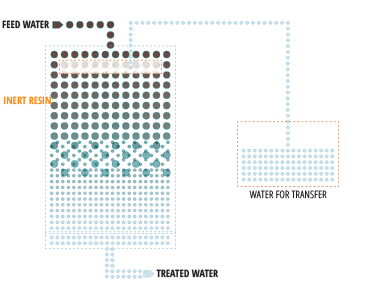
Gemwater designs various IX Exchange Resin Process with internal and external regeneration systems. For internal regeneration method, Gemwater developed and advanced countercurrent process, called “ResinBlock”. In ResinBock regeneration a neutral synthetic resin is placed above the ion exchange resin bed, filling all free board and to top head of the vessel, so to block it down during the reagent upflow injection.
Most popular related searches
ion exchange resin
ion exchange
ion exchange process
wash water consumption
wash water
backwash
water saving
water recycling
internal tanking
demineralization
This synthetic resin has the following characteristics:
- Inert as far as ion exchange reactions are concerned, resistant to the chemicals employed in the process.
- Sufficiently compressible.
- No changes in volume of the resin bed which occur during the regeneration and or exhaustion cycles.
- Floating and specific gravity lower than ion exchange resin and water.
The ResinBlock provided by Gemwater Process differs from other conventional ion exchange processes in very few respects, here below summarized:
- The synthetic resin is placed to ensure sufficient compression to ion exchange resin bed to hold it absolutely tight over the latter’s entire area and depth during the counter current regeneration cycle. Thereby it prevents any resin fluidification, so reducing its regeneration efficiency .
- The compression bed can remain in place during the normal treatment cycle, inside the vessel, since the additional resistance offers to the flow across the unit is no more than a few centimetres for water. This is again responsible for distinct advantages in operation.
- Regeneration is simple, the same and straightforward operation as with the co-current method.
- Process does not require any complicate controls or special aids.
- Regeneration is performed by introducing the chemical regenerant solution from the bottom to the top of the exchange unit. The pressure exerted by the compression bed above the resin contributes in particular manner to a uniform pattern of flow through the bed of resin.
- Backwashing is carried out by the same method as regeneration, only with water instead of regenerants.
- After backwashing of ion exchange resin has been completed, the compression bed can be returned to the unit by hydraulic flow transferring of the inert resin from a vessel to other one. When two demineralisation trains have to be installed, only one vessel of each type contains the synthetic resin for compression bed. This is automatically transferred into the vessel that requires regeneration to keep tight the resin-bedding pattern.
- Simple, straightforward attendance.
- Absence of additional tank internals ensures favourable flow conditions during exchange process and regeneration.
- No additional service water or air flows to produce static backpressure. This cancels out elaborate controls and complicate operating procedures.
- Process technology is not affected from load or flow fluctuations.
- Low height of units results in low wash water consumption. Together with saving a second regenerating media, this means a low level of running costs.
- In order to save service water, the recycled final rinse (last regeneration step sequence) is applied, whenever possible.