


JetmillMFG
- Home
- Companies
- JetmillMFG
- Products
- JetmillMFG - Air Classifier for ...
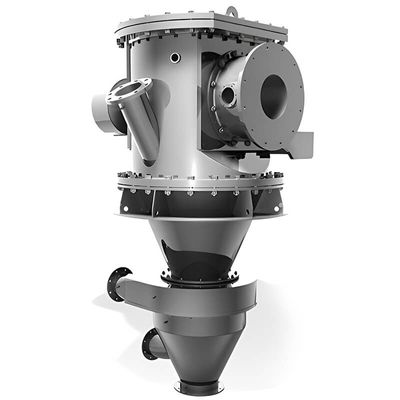
JetmillMFG - Air Classifier for Ultra-Fine Powder Classification
FromJetmillMFG
The Air Classifier offered by JetmillMFG is engineered to achieve precise particle size classification essential for various industrial applications, including ceramics, 3D printing, and more. This unit employs both air resistance and centrifugal forces to segregate particles into defined categories by size. This device can handle ultra-fine powders with the accuracy needed for stringent application demands, ensuring products like zirconia powder maintain optimal diameters and metal powders achieve uniform sphericity. The equipment's design incorporates a reliable mechanism that facilitates the separation of powders into fine and coarse streams, critical for enhancing the quality and functionality of powdered materials. JetmillMFG leverages its substantial expertise in particle size reduction and drying technology to ensure clients receive optimized solutions tailored to their processes.Most popular related searches
air classifier
particle sizing
particle size reduction
particle size distribution
air intake
size reduction
cyclone separator
centrifuge
size reduction system
workplace air
The realization of powdered material functionality often requires the particle size to meet certain conditions. For example, Zirconia powder for ceramic glaze requires an average particle diameter of 1-2 microns. Metal powder for 3d printing requires good sphericity, fine particle size and narrow particle size distribution. It is necessary to classify the powder particles to meet for specific applications.
Classification is the operation of separating the powder into two groups of large and small particles. In an air classifier, the powder is subjected to air resistance and centrifugal force, thus accomplishing the operation of classifying ultra-fine powders.
- The materials enter the classification area with the rising airflow.
- Under the strong centrifugal force generated by the classifying wheel, the coarse and fine particles are separated.
- Fine particles enter the cyclone separator through the classification wheel.
- The other particles drop to the secondary air inlet.
- Coarse and fine particles are separated again through the secondary air.
- Rejected material is discharged at the bottom of the classifier.
- Super fine classification at micron-level, suitable for spherical, flake, and needle-like particles
- Particle size cut-point in the range 1 to 100 microns
- Precise on-stream control of cut-point by variation of rotor speed and airflow
- High classification efficiency up to 90%
- Multiple classifiers can be used in series for multiple particle size ranges at the same time.
- PLC control, real-time monitoring of the running