


- Home
- Companies
- Kore Technology Limited
- Products
- Kore - Model PTR 3C - PTR-TOF-MS - Mass ...
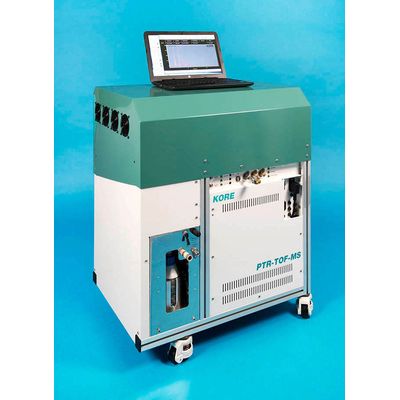
Kore - Model PTR 3C - PTR-TOF-MS -Mass Spectrometer
Kore Technology designed the world’s first time-of-flight mass spectrometer to couple to a proton transfer reactor back in 2002, and we have continued our innovation since. Our latest development is the PTR 3c. The Compact PTR 3c is a new soft chemical ionisation tool for sensitive analysis of VOCs in ambient air. Using soft chemical ionisation, the time of flight mass spectrometer can monitor all masses in parallel, allowing the maximum amount of information to be collected. The Kore PTR 3c has been developed to be transportable and can be taken on-site (mains power required), with full computer control of instrument parameters.
PTR-MS is a soft ionisation method utilising H3O+ ions to transfer protons to all compounds with a higher proton affinity than water. General components in air are not ionised by the hydronium beam, but most volatile organic compounds (VOCs) are ionised by H3O+ with little or no fragmentation. Other molecules such as hydrogen sulphide (H2S), hydrogen cyanide (HCN) and ammonia (NH3) can be detectable by this H3O+ PTR-MS method.
Ionisation takes place in a low pressure reactor (0.1 to 2mbar) under dilute conditions i.e. avoiding competition for charge between different analyte molecules, as might happen with API sources. The result is very high sensitivity combined with linearity and simple quantification. The same hardware can also be used with other reagent ions if desired O2+ and NO+ are common choices.
This feature uses fine, stepper motor control of a needle valve in order to maintain the reactor pressure at a constant, user-defined pressure. The pressure of the reactor is constantly monitored by a capacitance manometer and the signal can be used to feedback and maintain the reactor pressure constant.
REAGENT GAS METERINGWhether using H3O+ as the reagent ion or another gas to produce a reagent ion such as O2+, a solid state device measures the reagent gas flow into the glow discharge ion source, thus enabling the reagent flow to be set accurately and to be repeatable.
PTR MONITOR SOFTWARE
A new, dedicated software utility controls and displays key parameters that determine the collision energy inside the reactor. The reactor pressure and temperature are entered by the user, and these are used for feedback control of these parameters. The resultant E/n value is calculated in real time and displayed. These key parameters are subsequently stored with the data set. The reagent gas metering flow rate is also displayed in this utility.
HIGH MASS RESOLUTION, HIGH MASS ACCURACY TOF SPECTROMETER
All control voltages of the mass spectrometer are now under full computer control with read-back facilities. The instrument operates with a mass resolution of ~3000 at full transmission (high sensitivity), but the resolution can be increased further with some transmission losses. This can be useful, for example, where obtaining data at the highest resolution reduces the uncertainty of the exact mass of an unknown peak of interest.
SILCOSTEEL-COATED ANALYTE LINES
Now, as standard, all stainless steel surfaces leading to the reactor and that are in contact with analyte gas, including the pressure-determining needle valve, are coated with an inert coating to prevent adsorption of analytes such as small, sulphur-containing molecules.
EASY-TO-SERVICE ANALYTE INLET AND REACTOR SYSTEM
In a well-used instrument, the cathode of the glow discharge ion source requires periodic cleaning. The architecture and the fittings used for the reactor oven and inlet gas lines has been completely redesigned to allow easy disconnection and, importantly, the ability to reconnect with assurance of vacuum integrity. The inlet system can now be disassembled and reassembled under vacuum within one hour.
- Concentration range: 50ppm to ppt levels
- Sensitivity: >200cps/ppbv VOCs (measured with Benzene)
- Detection limit: ~10ppt
- Response time to concentration changes: ~100ms
- Mass resolution at max sensitivity: >3000 m/δm (FWHM) at m/z 79
- Mass resolution: ~4,000m/δm achievable
- Mass range: unlimited; in practice: 1000m/z (limited by gas phase thermochemistry)
- Glow discharge ion source: reagent ions H3O+ , O2+ , NO+
- Dimensions: 920 x 730 x 530mm
- Weight: ~150kg
- Power requirement (normal operation): <750W
- Reactor oven heating: 30-130°C (150°C transfer line available)
- Fully computer-controlled operation, automatic analysis software function
- Option for computer-controlled reagent ion switching
- Option for mass calibration unit (injecting low levels of high mass compound)
APPLICATION AREAS
- Live VOC monitoring while driving (ambient air, product quality control and testing)
- VOC analysis
- Clean room air quality monitoring
- Breath analysis
- Food analysis
- Homeland security
- Odour identification (buildings, factories etc)
- Fence line monitoring
APPLICATION NOTES