


- Home
- Companies
- Kratos Analytical Ltd.
- Products
- Kratos - Model Minibeam 6 - Gas Cluster ...
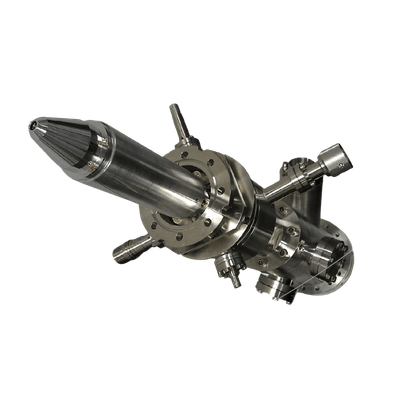
Kratos - Model Minibeam 6 -Gas Cluster Ion Source (GCIS)
This multi-mode gas cluster ion source is designed to operate in both Arn+ cluster and Ar+ monatomic modes making it suitable for sputter cleaning and depth profiling organic, inorganic and metallic thin films. In addition it may also be used to generate low energy He+ ions for use with ion scattering spectroscopy (ISS).
When introduced almost a decade ago, the Minibeam 6 gas cluster ion source represented a step change in sputter depth profiling capability. It provided a clean, reliable way to successfully sputter depth profile through polymer materials. This capability was quickly recognised and the use of cluster ions for depth profiling increased almost exponentially.
For inorganic materials, the sputter yields when using cluster ions are significantly lower. This means that depth profiling experiments are much longer than organic depth profiles. The lower etch rates can be mitigated somewhat by using smaller, higher energy cluster ions, with the major advantage of less chemical damage when compared to conventional monoatomic sputtering.
The capabilities of the Minibeam 6 GCIS are outlined below.
The multimode gas cluster ion source provides the capability to depth profile polymer, inorganic and metallic samples through a choice of giant gas cluster or monatomic argon ions. Easy control of both the cluster size and ion energy allows the appropriate partition energy (energy per atom) to be used for the application whilst maintaining suitable sputter yields per incident ion.
Small clusters at high energy (20 keV, Ar1000+) are useful for depth profiling inorganic materials and demonstrate significantly improved retention of stoichiometry when compared to monatomic Ar+ profiles.
Large, lower energy clusters (5 keV, Ar3000+) are employed for removal of surface contamination of polymer materials whilst medium energy, large clusters (10 keV, Ar3000+) are suitable for extremely deep profiling of organic materials.
The nozzle within the GCIS is used to generate the Ar clusters coaxial to the primary axis of the GCIS. High pressure Ar gas is introduced behind the nozzle. The pressure of the Ar gas behind the nozzle is referred to as the stagnation pressure. As the Ar gas expands from high pressure P0 into the lower pressure regime P1 it undergoes supersonic adiabatic isentropic expansion. The rapid cooling causes the Ar gas to form clusters, where the dimensions of the nozzle and the gas pressure control the size distribution of the clusters.
Skimmer
The skimmer region is differentially pumped by a dedicated turbomolecular pump (TMP). The skimmer is a precision engineered cone with an aperture used to ensure that the supersonic beam of Ar clusters is not reflected back towards the nozzle. The clusters pass a second aperture before entering the electron impact ionisation region.
E.I. ionisation region
The electron impact ionisation region comprises a hot cathode filament adjacent to a high transmission grid. The electrons are accelerated towards the grid but collide and ionise either Ar atoms or Ar clusters dependent on the operation mode of the ion source. The resultant ions are extracted from the E.I. region by the negatively biased extractor electrode. The ions then travel through the ion column which has 2 primary elements, the condenser and focus lenses.
Wien filter
The Wien filter is a crossed electrostatic and permanent magnetic field which is used to mass filter the ions.
Bend electrodes
As the name suggests, the bend electrodes send the ions through a small angular deflection. The purpose of this element is to ensure that no energetic atoms or meta-stable clusters are transported to the sample. Only charged ions will be deflected.
Raster & focus electrodes
The focus and raster electrodes are common to most ion sources. They are used to define the ion spot size and raster the focussed spot across the sample during sputter depth profiling and sample cleaning. This ensures that any inhomogeneity in the ion beam is averaged across the surface during the etching cycle.
Versatility of the GCIS Minibeam 6 means that it finds use across a large number of material applications groups. Highlighted here are a number of its most common application areas, with applications notes generated in our lab. There are also numerous publications in peer reviewed journals.
The GCIS provides significant enhancement of capabilities over the standard monatomic ion source. The use of large, low energy cluster ions ensures retention of chemistry when profiling soft, organic materials. Alternatively, selecting a small cluster, high energy mode facilitates the sputtering of inorganic materials, whilst minimising preferential sputtering and chemical damage. Using the monatomic mode means that metallic thin films can also be sputtered.
The application notes highlighted below demonstrate the diverse capabilities of the gas cluster ion source.