


- Home
- Companies
- Krušik-plastika ad Osecina
- Products
- Krusik - Pumping Shafts (Pumping ...
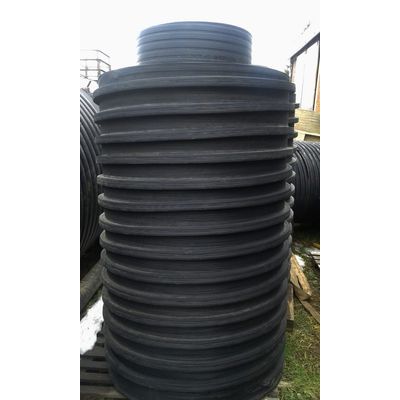
Krusik - Pumping Shafts (Pumping Stations)
They are of a similar design as sewage manholes, they also consist of spirally-wound body – cylinder on which the bottom and appropriate fittings are welded. They are also intended for burial, but their function is somewhat different. They serve as pumping-out stations or temporary collectors – they recieve wastewaters from sewage, rainfall or drainage sewages or from industrial wastewaters which flow into the shaft by gravity flow. At the bottom of the shaft the propper pump is placed – this is so called submerged pump, which pumps out collected wastewaters towards the proper common collector. These pumps are also called mud-pumps or faeces pumps, which are used for pumping out of water which contains mud and some rigid and solid particles.
They are usually vertical type but they can also be horizontal.
These shafts are greatly used within the so called low-pressurized sewage system. Low-pressurized sewage system is such a system of drainage of communal wastewaters where the water from a single house, or from several houses or buildings flows into the shaft by gravity flow through household sewage pipes of DN 110 to 160 mm, enters the collection – pumping shaft in which the special mud pump is already installed. This pump turns on automatically in the moment when the wastewaters inside the shaft reach the appropriate level. In a short time the pump throws out almost the entire content of the shaft, forcing it all the way to the common collector, main pumping station or purification plant, through highpressure pipes of diameters from DN 40 to 63 mm. The pump, as has already been stated, operates for a very short period of time and in accordance with that it consumes relatively small amount of energy and it has a long-lasting lifetime.
The advantages of such a sewage system, when compared to classic gravity sewage systems, are as follows:
- they are suitable for application in low-land areas, where it is not easy to obtain a gravity pipeline slope, as well as in mountainous areas, rocky and rigid soils, where digging of large rows for gravity pipelines is quite difficult,
- smaller burial costs, having in mind relatively small diameters of outlet pipelines as well as the fact that there is no need for deep burial – it is quite enough to bury deep enough to prevent freezing inside the outlet pipelines,
- it is easy to adapt outlet pipeline burial to terrain contours as well as to avoid traffic ways and existing infrastructure facilities and objects,
- unlike the gravity sewers, ground waters as well as traffic load have almost negligible influence on the low-pressurized sewage pipelines.