


- Home
- Companies
- Dragon Water Technologies Ltd (DWT)
- Products
- dynaBLEND - Liquid Polymer Blending ...
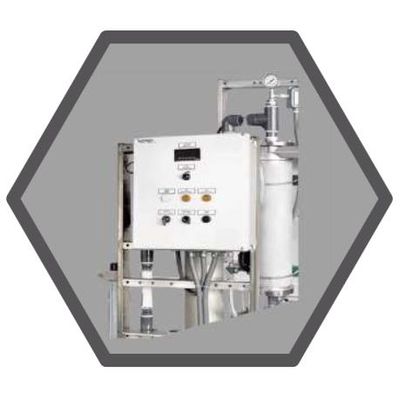
dynaBLEND - Liquid Polymer Blending System
In 1985 Fluid Dynamics developed the high energy, non-mechanical dynaBLEND™ liquid polymer activation and blending technology. Immediately it proved to be a revolutionary and great improvement in polymer activation and blending performance. Today, the dynaBLEND™ system remains the most effective and reliable polymer activation technology—rendering mechanical blenders obsolete except for low flow applications.
Knowing the critical requirements of polymer blending is the first step in understanding the numerous benefits of dynaBLEND technology. Over the years, the spectrum of available polymers has widened. Today there are more difficult to blend polymers than ever before. Some polymer blending systems work well on simple-to-blend polymers but fail to effectively activate many other polymers.
As-Supplied or Concentrated Polymer—Polymer is a long chain molecule having positive (cationic), negative (anionic) or neutral (nonionic) charge sites. In its as supplied, concentrated form, the polymer is tightly coiled. In this state, the polymer is not susceptible to damage from high mixing energy.
Effects of Insufficient Mixing Energy—When insufficient mixing energy is applied, polymer gelling or agglomeration occurs, resulting in the charge sites not being fully exposed. Overdosing of polymer is required to achieve desired performance.
Effects of Overexposure to Mixing Energy—Overexposing polymer to mixing energy after initial activation will damage the fragile long chain molecule. Again, overdosing of polymer is required.
Fully Activated Polymer—Unwinding and elongating the coiled polymer molecule is necessary to expose the maximum number of charge sites to your process. The job of the polymer activation and blending system is to gently and thoroughly activate polymer. Fully elongated, undamaged polymer is the most active and effective form yet also the most fragile state. Continued exposure to mixing energy in this state will damage the fragile polymer.
- “Infinite Shear in Zero Time.” Apply ultra-high mixing energy at the point of initial polymer and water contact to prevent polymer gelling or agglomeration. Currently the polymer is coiled-up and not susceptible to damage.
- Create the right environment. Polymer solution has proven to be the ideal environment for polymer activation, as opposed to raw water. Inject neat, concentrated polymer into polymer solution, not raw water.
- Prolonged turbulence. Expose polymer to prolonged turbulence in order to complete the blending process gently and fully.
- Avoid damaging mixing energy after the polymer is initially activated so as not to break the fragile molecular chain.
While some polymer systems can only work well on the simple-to-blend polymers, dynaBLEND has a proven track record of effectively activating all types of polymer. dynaBLEND is the standard for manufacturers of ultra-high molecular weight and high solids type polymers.
dynaBLEND is designed for reliability. The non-mechanical dynaBLEND mixing chamber design inherently delivers an unequalled degree of reliability over many mechanical technologies. But we don’t stop there. The polymer injection check valve is a potential maintenance issue in any polymer system. Fluid Dynamics designed the PCV valve, a large port check valve with spring-loaded stainless-steel ball and PVC body. The PCV valve easily disassembles for inspection or cleaning simply by pulling a two-prong stainless steel pin.
Highest Quality = Lowest Life-Cycle Cost! dynaBLEND is the benchmark for quality in our industry. Why? Because of the value of longevity. dynaBLEND quality is achieved by building a more rugged system with higher quality components and tight quality control using highly skilled people.
With quality comes confidence. dynaBLEND is backed by the longest warranty in our industry—two (2) year system warranty and lifetime mixing chamber warranty.
Consider your investment—whether it be a centrifuge, belt filter press, clarifier, filter, paper machine, or whatever your process requires, your investment is substantial. Doesn’t it make sense to protect this investment? A polymer blending and activation system can dramatically affect the performance and reliability of this process.
- Proven Performance
- Proven Reliability
- Proven Quality
A system that will deliver the lowest life-cycle cost.
The Proven Solution
- Two Year System Warranty
- Lifetime Mixing Chamber Warranty
- Total Satisfaction Guarantee
Because controls are an integral part of every dynaBLEND system, Fluid Dynamics has developed the widest range of standard control panels available. Beginning with a simple discrete controller, through microprocessor-based controllers, all the way up to versatile PLC-based systems with touch screen interfaces and a variety of communication options, there is likely to be a pre-engineered system to meet your needs. If additional features are required, Fluid Dynamics’ electrical and software engineers, along with the UL panel shop will develop a custom solution for your application.
Control and Instrument Options
Control Panel Options are shown on pages 10 and 11. Some of the available features include or allow the selection of accessories or options. These options are described below.
Pump Control
Peristaltic Pumps can be furnished with manual or automatic speed control. Automatic control models accept a 4-20 mADC pacing signal which varies the speed of the pump. Pacing feature is available on all control levels except Control Level 1.
Progressing Cavity Pumps are offered in manual or automatic models. Automatic models accept a 4-20 mADC pacing signal, which varies the speed of the pump. Pump speed is interpolated as an indication of polymer flow where budgetary constraints do not allow more sophisticated polymer flow measurement. Pacing feature is available on all control levels except Control Level 1.
Water Measurement
Differential Pressure Switch—A non-quantitative device used to sense the loss of water flow. Alarm and system shutdown are provided on loss of water flow. This feature is standard on Control Level 3 and optional on Control Levels 4, 5 and 6.
Rotameter—A quantitative device which allows water flow rate to be observed locally. Standard on all units unless a higher-level control is selected.
Turbine Flow Meter—A quantitative device which measures water flow and provides a signal to indicate the water flow rate. This signal is used to display the flow rate and/or as a part of the ratio control feature. This feature is standard for Control Levels 4, 5 and 6 and is optional on Control Level 3.
Magnetic Flow Meter—An alternative to the Turbine Flow Meter available to meet customer preferences. This feature is optional and available only on Control Levels 4, 5 and 6.
Polymer Measurement
Calibration Column—A pump draw-down cylinder is standard on all systems.
Thermal Flow Sensor—A non-quantitative device used to sense loss of polymer flow. Alarm and shutdown are provided when loss of polymer flow is sensed. This feature is optional on Control Levels 3, 4 and 5 and standard on Control Level 6.
Mass Flow Meter—A quantitative device which is a highly sensitive instrument used to measure the flow of non-conductive and viscous liquids such as polymer, accurately, even at very low flows. The device provides a signal proportional to flow which may be used to display polymer flow rate and/or as the basis of the dynaBLEND ratio control feature with the highest accuracy. This option is available only on Control Levels 4, 5 and 6. When this option is selected, the thermal flow sensor is not required.
Auto Flush
Automatically initiated flush cycle. Cycle time is adjustable. Standard on Control Levels 4, 5 and 6; optional on Control Level 3.
Fluid Dynamics, Inc. offers dynaBLEND Liquid Polymer Blending Systems with a variety of pre-engineered control configurations, including local, remote, microprocessor and PLC. All control enclosures are rated NEMA 4X. Standard power is 115 VAC. UL certification is standard on all but Level 1 controls.
All units include manual polymer pump rate control. Control Levels 3 and higher are designed to accept a pacing signal for remote speed adjustment of the polymer feed pump. All progressing cavity pumps are provided with a variable speed drive with local rate indication. Peristaltic pumps feature speed control.
Control Levels 3, 4 and 5 are available with an optional alarm indicating loss of polymer flow, derived from aa thermal flow sensor. This option is not available with pumps operating below 0.76 lph (0.2 gph). This feature is included on Control Level 6.
Control Levels 1 and 3
Control Levels 1 and 3 are discrete control systems using relay logic and isolated contact I/O.
Level 1
- LOCAL-OFF-REMOTE Selector Switch
- RUN Indicating Light
- Manual Pump Flow Rate Adjustment
- Alarms: None
- Inputs: Remote ON-OFF (Discrete)
- Outputs: Running (Discrete)
- Remote Mode (Discrete)
Level 3
- LOCAL-OFF-REMOTE Selector Switch
- RUN Indicating Light
- Manual or Automatic Pump Flow Rate Adjustment
- Alarms: Low Water Differential Pressure
- Inputs: Remote ON-OFF (Discrete)
- Pacing of Metering Pump (4-20 mADC)
- Outputs: Running (Discrete)
- Remote Mode (Discrete)
- Low Water Diff. Press. Alarm (Discrete)
- Optional Low Polymer Flow Alarm (Discrete)
Option – AUTO FLUSH can be added to Level 3 controls.
Option – Low polymer Flow Alarm (TFS)
Control Level 4
Control Level 4 includes a microprocessor-based ratio control device capable of maintaining a precise solution concentration while following the manually adjusted dilution water flow rate.
- Microprocessor Control with Touchpad Input
- Ratio Control of Polymer to Dilution Water*
- LOCAL-OFF-REMOTE Selector Switch
- Running Indication
- Pump Rate Indication
- Water Rate Indication
- Solution Concentration Indication
- Auto Flush
- Alarm: Low Water Flow
- Optional Low Polymer Flow Alarm
- Inputs: Remote On-Off (Discrete)
- Pacing of Metering Pump (4-20 mADC)
- Outputs: Running (Discrete)
- Auto Flush Mode (Discrete)
- Low Water Flow Alarm (Discrete)
- Polymer Pump Rate (4-20 mADC)
- Optional Low Polymer Flow Alarm
Control Level 5
Control Level 5 includes a microprocessor-based ratio control package to maintain a precise polymer solution concentration. The device is configurable, through a local touchpad, to allow either water or polymer to follow a 4-20 mADC pacing signal. The non-paced flow is controlled automatically to maintain the desired solution concentration. Polymer solution concentration may be adjusted locally or by a second remote 4-20 mADC signal. When operating in a fully automatic mode, water flow is controlled automatically using an integral linear actuated variable orifice (LAVO).
- Microprocessor Control with Touchpad Input
- Ratio Control of Polymer Solution Concentration
- Local Input Through Touchpad
- In Response to a Remote Signal
- LOCAL-OFF-REMOTE Selector Switch
- Running Indication
- Water Rate Indication
- Solution Concentration Indication
- Auto Flush
- Alarms: Low Water Flow
- Solution Concentration FAULT 2
- Optional Low Polymer Flow Alarm
- Inputs: Pacing Signal (4-20 mADC) 1
- Solution Concentration (4-20 mADC) 1, 3
- Remote On-Off (Discrete)
- Outputs: Running (Discrete)
- Remote Mode (Discrete)
- Auto Flush Mode (Discrete)
- Common Alarm (Discrete)
- Polymer Pump Rate (4-20 mADC)
Control Level 6
Control Level 6 incorporates a PLC with a touch screen interface to maintain precise control of polymer solution concentration and flow rate. The system is configurable, through the integral touch screen, to select either water or polymer to follow a 4-20 mADC pacing signal. The non-paced flow is controlled automatically to maintain the desired solution concentration. Polymer solution concentration may be adjusted locally or by a second remote 4-20 mADC signal. When operating in a fully automatic mode, water flow is controlled automatically using an integral linear actuated variable orifice (LAVO).
- PLC Control with Touch Screen Interface
- Ratio Control of Polymer Solution Concentration
- Local Input Through Touch Screen
- In Response to a Remote Signal
- LOCAL-OFF-REMOTE Selection (Touch Screen)
- Running Indication
- Water Rate Indication
- Solution Concentration Indication
- Auto Flush
- Alarms: Low Water Flow (Adjustable Set Point)
- No Polymer Flow (Thermal Flow Sensor)
- Solution Concentration FAULT 2
- Optional Low Polymer Flow Alarm
- Inputs: Pacing Signal (4-20 mADC) 1
- Solution Concentration (4-20 mADC) 1, 3
- Remote On-Off (Discrete)
- Outputs: Running (Discrete)
- Remote Mode (Discrete)
- Auto Flush Mode (Discrete)
- Common Alarm (Discrete)
- Solution Flow Rate (4-20 mADC)
- Polymer Pump Rate (4-20 mADC)
- Dilution Water Flow Rate (4-20 mADC)