


- Home
- Companies
- Alliance Instruments GmbH
- Products
- Loop Flow Analysis System (LFA)
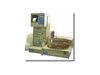
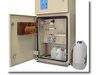
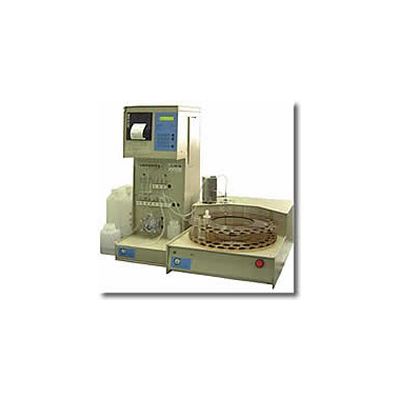
Loop Flow Analysis System (LFA)
The Loop-Flow Analysis was developed in the beginning of the nineties by our partner Systea. LFA is a new and patented technique to carry out colorimetric analysis procedures inside a hermetically closed Loop. Designed with a glance to sea water analysis on board of expeditions, LFA offers several specific advantages. The combination of outstanding stability at lowest concentrations, very compact components and extremely small demand on energy and reagent makes a unique analyser, suitable to solve applications where no convincing solution was available before.
All the steps of a wet-chemical colorimetric analysis method are carried out in an analysis cycle sequentially. The hermetic closed Loop provides full protection against background interference, a basic requirement for stable trace analysis. In the begin of a cycle the loop is washed and filled with sample. The sample colour is measured for compensation. Small amounts of concentrated reagents are added and mixed with high intensity.
This minimum of sample dilution helps to obtain best sensitivity. Along the specified reaction time the solution is temperature controlled if required to speed up or stabilise the reaction. The detection at the specific wavelength is carried out in a double beam colorimeter, the lightpath (5/10/50 mm) is adapted to the application. If automatic dilution is foreseen, a part of the sample is mixed with water in the first steps of the cycle. Upon detection of off-scale concentration a dilution and re-analyse can be carried out automatically.
The calculation of measured results is based upon the measured and stored values of reagent blank and internal calibrant solution. Results are stored in the instrument memory and sent to *integrated printer or to serial port. Optional modules are available for sample preparation procedures or special reaction steps. Dialysis removes interfering sample matrix by diffusion membrane. UV digestion mineralizes organic P or N compounds. Multi-parameter configurations of LFA analysers are available. The production of working reagents and analyser maintenance is carried out by the user following instructions. Extremely reliable components provide a lifetime of 200.000 analyses.
The calculation of measured results is based upon the measured and stored values of reagent blank and internal calibrant solution. Results are stored in the instrument memory and sent to *integrated printer or to serial port. Optional modules are available for sample preparation procedures or special reaction steps. Dialysis removes interfering sample matrix by diffusion membrane. UV digestion mineralizes organic P or N compounds. Multi-parameter configurations of LFA analysers are available. The production of working reagents and analyser maintenance is carried out by the user following instructions. Extremely reliable components provide a lifetime of 200.000 analyses.
- Settings for analysis cycle (method) stored in instrument memory
- Membrane keyboard for operation of analysis and access to settings
- LCD display results, alarm and communication menue
- Double-beam colorimeter with monochromatic source, 0.001-1.300 AU
- Automatic range expansion, automatic sample dilution
- Reagent demand about 100µl each analysis
- Energy demand 4W in stand by, about 10W in analysis
- Industrial design IP65 (* depending on instrument type)
- Unbeatable sensitivity and stability, thanks to patented LFA technique
- Hermetically close analysis loop
- Compensation of individual sample colour
- Complicated and individual sample preparation and reaction procedures can be applied on the analyser
- Extremely small reagent demand and energy consumption, most compact colorimetric analysis components
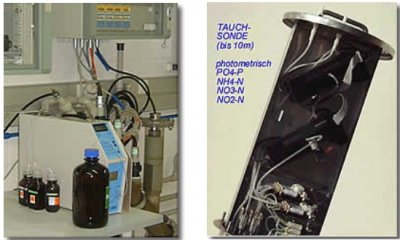
- Unique nutrients probe analyser (submergible!) thanks to LFA features
- Long term online/in situ autonomy
- Simple operation and maintenance