


- Home
- Companies
- Hardy Process Solutions
- Products
- Loss-In-Weight Rate Control
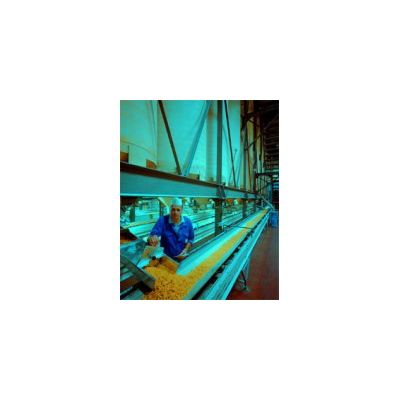
Loss-In-Weight Rate Control
Rate by weight is the measurement of an amount of a material which enters into or is dispensed from a vessel over a given period of time. Solids, liquids, or gases can be monitored or precisely controlled using screw- or auger-based feeders, vibratory feeders, conveyors, belt feeders, augers, variable valves and pumps.
Moving material
Material is commonly moved in a process in either of two modes: volumetric or gravimetric. In the volumetric mode, a known volume of material is moved per unit of time at a given speed. In the gravimetric mode, the variable setpoint of weight is divided by a variable of time (ex. lb/min) to determine a mass flow rate.
In the gravimetric mode, material is moved at a controlled rate around the given setpoint. This mass flow or "weight by rate" can be used in a continuous or batch process. A continuous process has material constantly flowing at a controlled rate. In a batch process, material flows at a controlled rate and is totalized until a pre-determined setpoint amount is reached.
Monitoring Rate-of-Flow
Hardy`s instrument can either monitor or control flow rate. A Hardy weight controller can monitor the rate-of-change, but offers no control of the rate-of-flow. It gives a snapshot of the amount of weight passing over, out of, or onto a scale at any given time. For example, material on a conveyor belt (a section of which has a scale under it), can be monitored to determine a constant weight. Varying or wild flow applications, such as when an aggregate is added to a concrete mix, can also be monitored.
Data is displayed locally or transmitted as a serial, analog, or BCD signal to a remote device, such as another instrument, printer, computer, or programmable logic controller (PLC). This remote device can then perform a wide variety of control functions, including adding micro-ingredients, controlling temperature, mixing, sorting, or packaging the end-product.
Controlling Rate-of-Flow
When controlling rate-of-flow, a Hardy rate controller is used with an appropriate feeding device and scale to achieve precise flow rates, even in grams per minute. Material is weighed as it is dispensed from the feeder, using closed loop P.I.D. (proportional, integral, & derivative) control. The feeder can be automatically refilled (gain-in-weight) while simultaneously delivering the desired amount of product at the desired rate (loss-in-weight).
The quantity of material dispensed can be monitored and saved internally, or transmitted serially to printers or computers to meet inventory or statistical requirements. Hardy`s rate controller offers a variety of interfaces to communicate to computers, PLCs and distributed control systems. This includes RS-232 or 422/485, and an interface to Allen-Bradley`s Remote I/O network. A Profibus DP interface is also available to communicate with Siemens and Texas Instruments PLCs.
The Hardy controller can also set off an alarm or shut down the process if rate tolerances or weight limits are exceeded. Timers can be adjusted in the instrument to determine how long the system is allowed to run in an "out of tolerance" condition before an alarm or shutdown occurs. This prevents accidental shutdown or triggering of the alarms due to momentary spiking or noise on the signal.
Master/Slave Control
Multiple feeders can be set up in a master-slave configuration for automatic ratio tracking. This allows for the simultaneous blending of multiple ingredients and faster product throughput. The master ingredient can be a solid, which is controlled or monitored by an instrument and a feeder, or a liquid, which is controlled or monitored by a fluid flow meter or pump.
Typically, setpoint flow rates of slave ingredients are a ratio of the actual flow rate of the master ingredient. In some applications, the master ingredient will be controlled by an HI 2160RC Rate Controller, and the actual flow rate transmitted with the optional analog output. The flow rate of the master ingredient could also be determined by other instruments such as a fluid flow meter. In some instances, the setpoint flow rates of the slave ingredients are a ratio of some other parameter in the process, such as temperature or pressure.
PLC Rate Control
A central PLC or host computer can control the flow rate setpoints to multiple rate controllers. An example of this would be to have a common analog signal from the PLC to all of the rate controllers, as well as a separate PLC relay line to each. The PLC sends the rate setpoint (an analog signal) and momentarily closes a specific output relay line. The analog signal from the PLC can change, but only those controllers receiving the relay contact closure will respond to this new analog setpoint value. All other controllers will operate at the previously programmed rate.
WAVERSAVER
The movement of material in a rate control or monitoring process creates unwanted vibration forces on the scale. This vibration can affect the scale system`s accuracy and response time. Hardy`s WAVERSAVER technology ignores unwanted vibration signals to provide quick and accurate weight readings. Feeders can even be weighed while they`re running!
Data Security
Each Hardy weight or rate controller includes a Secure Memory Module (SMM) which automatically stores and protects against the loss or corruption of critical data, including calibration, setup, and operating parameters. If the instrument ever needs replacement, the SMM can be transferred to another instrument. All critical data is restored on power-up, putting your rate system back on-line within minutes.
Calibration Made Easy
System setup is easier than ever before with Hardy`s exclusive C2 scale calibration technique and fully automated rate calibration process. C2, Second Generation Calibration eliminates costly scale calibration fees associated with rate systems. It allows you to electronically calibrate without test weights, even with material in your vessel or scale.
The C2 system consists of Hardy`s C2 certified load points or platforms, controllers, junction boxes and cabling to make scale calibration easier than ever before. Each C2 certified load point or sensor contains digital information detailing its unique performance characteristics. The C2 system uses these characteristics to electronically calibrate the scale. When power is applied, the weight controller automatically searches for C2 certified load sensors and saves the data to memory. A reference point is entered by the operator and the scale is fully calibrated.
The C2 system reduces downtime for installation and repairs, and eliminates test weight related injuries. In addition, it ends material substitution headaches, including contamination and waste disposal issues.