LyoVec - Lyophilized Lipid-based Transfection Reagent
LyoVec is the first lyophilized cationic lipid-based transfection reagent belonging to the family of phosphonolipids. This family was originally described by Floch et al., as efficient transfection reagents for both in vitro and in vivo use [1-2].
The major constituent of LyoVec™ is the phosphonolipid DTCPTA, which is coupled to DiPPE, a neutral lipid that helps destabilize membrane bilayers and increases the in vitro transfection efficiency of LyoVec™.
Applications of LyoVec™:
- Cationic lipid-based transfection reagent
- Nucleic acid complexing agent
The positive charge of the phosphonolipid enables LyoVec™ to bind to plasmid DNA, and the structure promotes fusion with cellular membranes for efficient DNA delivery.
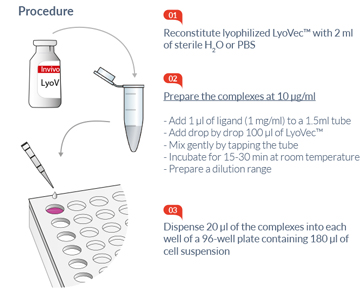
Additionally, LyoVec™ can be used as a nucleic acid complexing agent to facilitate the cellular entry of RNA or DNA-based oligonucleotides, such as RIG-I ligands (i.e. 5’ppp-dsRNA and 3p-hpRNA), cGAS ligands (i.e. HSV60 and VACV70), and endosomal TLR ligands (i.e. ssPolyU). This complexation step is crucial for inducing an effective response to the nucleic acids by pathogen recognition receptors.
Hands-on time: No more than 15 min and no preparation required the day prior transfection
Cell types: High efficiencies in a wide range of mammalian cells
Transfection: Transient and stable transfections
Conditions: Works in the presence of serum, with no need to wash cells after transfection
Shelf life: Long shelf-life of plasmid DNA (pDNA)/ LyoVec™ complexes
Quality Control:
- Transfection efficiency of LyoVec™ is evaluated using HEK-293 cells.
- The survival rate of HEK-293 cells exposed to LyoVec™ for 72 hours in medium containing 10% serum is >95%.