


InvivoGen products
Cell Culture - Cell Transfection
LyoVec - Lyophilized Lipid-based Transfection Reagent
LyoVec is the first lyophilized cationic lipid-based transfection reagent belonging to the family of phosphonolipids. This family was originally described by Floch et al., as efficient transfection reagents for both in vitro and in vivo use [1-2].
NATE - Nucleic Acid Transfection Enhancer
NATE is a nucleic acid transfection enhancer designed by InvivoGen to boost both transient and stable transfection efficiencies in hard-to-transfect cells; specifically human monocytes and murine macrophages (i.e. THP-1 and RAW 264.7 cells, respectively). Simply add NATE™ 30 mins prior to your current transfection protocol. The principal obstacle for ‘foreign’ nucleic acids (i.e. plasmids) during eukaryotic cell transfection is their own detection by cytosolic DNA sensors of the innate immune system (see `Details` tab). These defensive cellular strategies can greatly affect the efficiency of both transient and stable transfections. When using NATE™, a number of these nucleic acid sensing pathways will be inhibited, thereby protecting the plasmid and facilitating its expression.
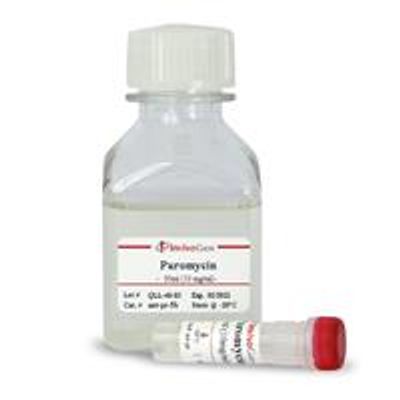
Puromycin Solution
Puromycin is an aminonucleoside antibiotic produced by Streptomyces alboniger.It specifically inhibits peptidyl transfer on both prokaryotic and eukaryotic ribosomes.This antibiotic inhibits the growth of Gram positive bacteria and various animal and insect cells.Puromycin can also be used in some particular conditions for the selection of E. coli transformants.Resistance to puromycin is conferred by the Pac gene encoding a puromycin N-acetyl-transferase.Animal cells are generally sensitive to concentrations from 1 to 10 µg/ml.
Cell Lines - PRR Ligands
InvivoGen - Model TLR2 - Ligands Cells
Toll-like receptor 2 (TLR2) is required for the recognition of a wide range of microbial molecules from Gram-positive and Gram-negative bacteria, as well as mycoplasma and yeast.
Cell Culture -Selective Antibiotics
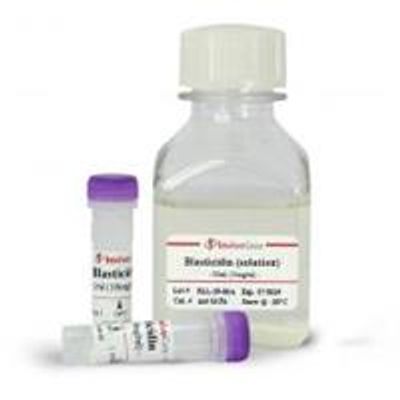
Blasticidin Solution
Blasticidin is an efficient selection antibiotic that acts on both eukaryotic and prokaryotic cells. Blasticidin is a peptidyl nucleoside antibiotic isolated from Streptomyces griseochromogenes that inhibits protein synthesis by interfering with the peptide-bond formation in the ribosomal machinery.
Resistance to blasticidin is conferred by the blasticidin resistance gene from Bacillus cereus (bsr), which codes for blasticidin-S deaminase [1].
Resistance to blasticidin is also conferred by the blastcidin S acetyltransferase gene (bls) from Streptoverticillum sp [2], and the blasticidin S deaminase gene (BSD) from Apergillus terreus [3].Typically, mammalian cells are sensitive to blasticidin concentrations of 1-10 µg/ml, and bacteria to 25-100 µg/ml. Cell death induced by blasticidin occurs rapidly, allowing for selection of transfected cell lines carrying a blasticidin resistance gene within one week.
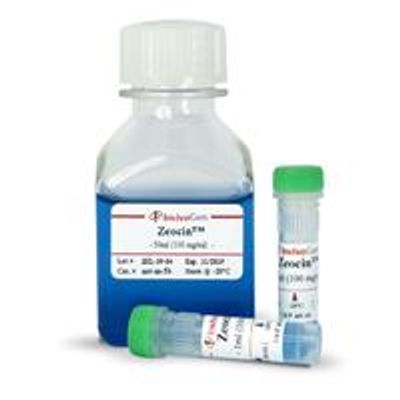
Zeocin™ - Zeocin Solution
Zeocin™ is a formulation of phleomycin D1, a copper-chelated glycopeptide antibiotic produced by Streptomyces CL990. Zeocin™ causes cell death by intercalating into DNA and cleaving it.The action of Zeocin™ is effective on most aerobic cells. Therefore, Zeocin™ is a popular and effective antibiotic for the selection of vectors bearing the Sh ble gene in a variety of cells types (bacteria, eukaryotic microorganisms, plant and animal cells).Resistance to Zeocin™ is conferred by the Sh ble gene product from Streptoalloteichus hindustanus, which inactivates Zeocin™ upon binding to the antibiotic.Sh ble is a small 370bp-sized gene and is carried in a number of InvivoGen’s vectors.Typically, mammalian cells are sensitive to Zeocin™ concentrations of 50-400 µg/ml, and bacteria to 25 µg/ml.
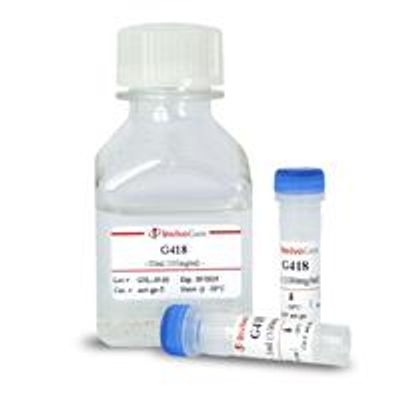
Model G418 - Geneticin Solution
G418 also known as G-418, G418 sulfate or Geneticin is an aminoglycoside antibiotic produced by Micromonospora rhodorangea.G418 blocks polypeptide synthesis by inhibiting the elongation step in both prokaryotic and eukaryotic cells.Resistance to G418 is conferred by the Neomycin resistance gene (neo) from Tn5 encoding an aminoglycoside 3` phosphotransferase, APH 3` II.Selection in mammalian cells is usually achieved in 3 to 7 days with concentrations ranging from 400 to 1000 µg/ml. Cells that are dividing are affected more rapidly than non-dividing cells.
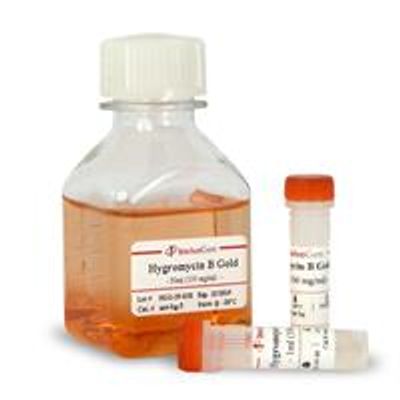
Hygromycin B Gold Solution
Hygromycin B is an aminoglycoside antibiotic produced by Streptomyces hygroscopicus. It kills bacteria, fungi and higher eukaryotic cells by inhibiting protein synthesis.It has been reported to interfere with translocation [1] and to cause mistranslation at the 70S ribosome.