


- Home
- Companies
- Malaman C.T.C.
- Products
- Malaman - Eddy Current Separator
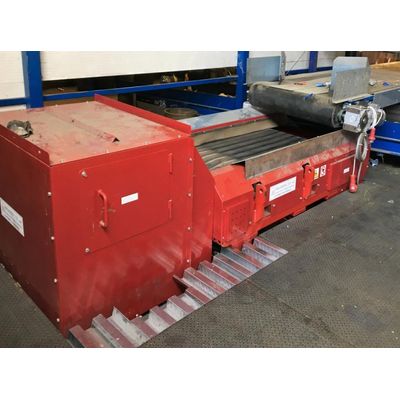
Malaman - Eddy Current Separator
An Eddy Current Separator is an advanced recycling device designed to separate non-ferrous metals from waste material. It operates on the principle of eddy currents, induced by a high-speed magnetic rotor, to efficiently divert non-iron metals such as aluminum, copper, and magnesium from the primary waste stream. The system features a motorized conveyor belt that rotates over a magnetic rotor housed within a dielectric cylinder. This rotor contains multiple grooves, filled with alternating north/south polarity permanent magnets, creating a powerful repelling force. The speed at which the rotor spins, exceeding 3,500 RPM, plays a crucial role in the frequency of eddy currents, influencing the separation efficiency based on metal conductivity and mass. Designed to handle various working widths and customizable to facility needs, these separators are crucial equipment in modern waste management systems aimed at resource recovery and recycling.
An Eddy Current separator makes use of the principle of eddy currents to separate non-ferrous metals from the waste stream. The eddy currents (also called Foucault’s currents) are generated by the machine’s magnetic rotor.
An Eddy Current Separator mechanically resembles a conveyor belt and it is usually installed in line in a waste recycling plant. The main purpose of the machine is to separate the Non-ferrous metals from non-metals or, eventually, recover fine ferrous metals that the iron-removers installed upstream did not attract.
HOW ARE THE EDDY CURRENT SEPARATORS MADE
The main component of the machine is the magnetic rotor.
The number of grooves in a magnetic rotor equals the number of magnetic poles. The poles are always a whole and equal number – it generally varies from 8 to 40.
A series of permanent magnets is installed in each groove alternating N/S polarity.
The magnetic rotor is then enclosed in a dielectric cylinder. The conveyor belt, made of rubber or PVC, makes this dielectric cylinder rotate.
Thanks to a system of flanges and counter flanges, it is possible to set different rotating speeds for belt and rotor. The speed of the magnetic rotor can reach over 3.500 rpm.
This explains the installation of two motors on the separator: a first motor-reducer to make belt rotate and a second motor directly connected to the rotor shaft with an elastic coupling.
HOW DO THE EDDY CURRENT SEPARATOR (ECS) WORK
When rapidly rotating, the rotor induces a stator current onto the metals contained in the waste stream. The N/S alternating field is generated by permanent magnets fitted into the grooves on the rotor’s surface. The effect of the eddy current is to induce a second magnetic field which reacts with the magnetic field generated by the rotor.
The result of this combination is a powerful repelling force that diverts Non-Fe metal intrusions from the remaining waste stream.
In order for the eddy current to be transformed into kinetic repulsive energy, the conductivity, resistivity and mass of Non-Fe metal has to be taken into account. To make it easier, the force that repels Non-ferrous metals is proportional to the object’s electrical conductivity/specific gravity ratio. The higher is this ratio, the stronger is the repelling force.
The easiest Non-ferrous metals to separate are: Aluminum (Al): ratio 13.1, Magnesium (Mg): ratio 13, Copper (Cu): ratio 6.6, Silver (Ag): ratio 6.5.
The most difficult Non-ferrous metals to separate are: Zinc (Zn): ratio 2.5, Tin (Sn): ratio 1.2, Lead (Pb): ratio 0.45.
The rotating speed of the rotor determines the frequency of the induced currents and, consequently, the repelling force.
EDDY CURRENT SEPARATORS WIDTH
With the term “width” we refer to the actual working width of the separator, i.e. the length of the rotor poles.
Our Eddy Current Separator, mod. IS 2R 1000 has a total belt width measuring 1200mm, while the actual working width measures 1000mm.
The size of the separator is established together with the customer according to the dimensions of their waste recycling plant and separation needs.
Malaman C.T.C. builds and produces Eddy Current Separators (IS-EC) with working widths from 500mm to 2.500mm and various types of machine frames.