


- Home
- Companies
- Kore Technology Limited
- Products
- Kore - Model PTR 2e PTR-TOF-MS - Mass ...
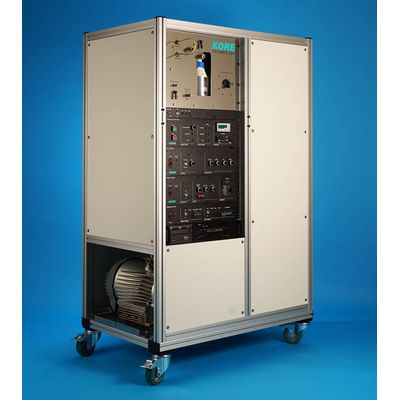
Kore - Model PTR 2e PTR-TOF-MS -Mass Spectrometer
Kore Technology designed the world’s first time-of-flight mass spectrometer to couple to a proton transfer reactor back in 2002, and we have continued our innovation since. We are pleased to present our larger, higher performance PTR-TOF-MS instrument, the PTR 2e.
Kore’s original PTR instrument has been re-designed to deliver:
- High sensitivity resulting in low detection limits for analyte species
- High mass resolution for unambiguous identification of chemical species
- A rugged, transportable instrument for use in field work
PTR-MS is a soft ionisation method utilising H3O+ ions to transfer protons to all compounds with a higher proton affinity than water. General components in air are not ionised by the hydronium beam, but most volatile organic compounds (VOCs) are ionised by H3O+ with little or no fragmentation. Other molecules such as hydrogen sulphide (H2S), hydrogen cyanide (HCN) and ammonia (NH3) can be detectable by this H3O+ PTR-MS method.
Ionisation takes place in a low pressure reactor (0.1 to 2mbar) under dilute conditions i.e. avoiding competition for charge between different analyte molecules, as might happen with API sources. The result is very high sensitivity combined with linearity and simple quantification. The same hardware can also be used with other reagent ions if desired O2+ and NO+ are common choices.
The Series 2e Kore PTR-MS features a new and novel PTR reactor with a Kore-designed ion concentrator as part of the reactor, capable of achieving > 200 cps/ppbv Benzene. This greatly reduces the ion losses that would normally occur in the reactor owing to a phenomenon known as ‘space charge’, in which high-density ions repel each other. This novel device channels the ions to the exit of the reactor, resulting in a high current ion beam passing into the next part of the instrument. This reactor and concentrator is also fitted to the Series 1 PTR-TOF-MS.
HIGH MASS RESOLUTIONThe Series 2e PTR-MS from Kore features a new spectrometer capable of delivering up to 8,000 mass resolution. For routine operation, the instrument operates at >5,000. The flight path is longer than the series I instrument, resulting in a lower repetition rate (pulse frequency), and this reduces the sensitivity somewhat from the smaller instrument, but with the added advantage of high mass resolution. Nevertheless sensitivity levels are still high even at high mass resolution with Benzene > 200 cps/ppbv.
RUGGED AND TRANSPORTABLE
The Series 2e PTR-MS instrument is designed for easy and safe transportation and yet with sufficient mass resolution and sensitivity to satisfy the most demanding applications. It is housed in a purpose-designed vertical rack to permit easy transportation in a standard van. The instrument is ‘floated’ inside the frame so that it is ‘cushioned’ during transportation.
- Concentration range: 50ppm to ppt levels
- Sensitivity: >200cps/ppbv VOCs (measured with Benzene)
- Detection limit: ~10ppt
- Response time to concentration changes: ~100ms
- Mass resolution at max sensitivity: >5000 m/δm (FWHM) at m/z 79
- Mass resolution: ~8000 m/δm achievable
- Mass range: unlimited; in practice: 1000m/z (limited by gas phase thermochemistry)
- Glow discharge ion source: reagent ions H3O+ , O2+ , NO+
- Dimensions: 1030 x 1630 x 650 mm
- Weight: ~230kg
- Power requirement (normal operation): <750W
- Reactor oven heating: 30-130°C (150°C transfer line available)
- Fully computer-controlled operation, automatic analysis software function
- Option for computer-controlled reagent ion switching
- Option for mass calibration unit (injecting low levels of high mass compound)
APPLICATION AREAS
- VOC monitoring (ambient air, product quality control and testing)
- Clean room air quality monitoring
- Breath analysis
- Food analysis
- Homeland security
- Odour identification (buildings, factories etc)
- Fence line monitoring
APPLICATION NOTES