


- Home
- Companies
- MDSJ Impianti
- Products
- MDSJ - Ceramic Filter System
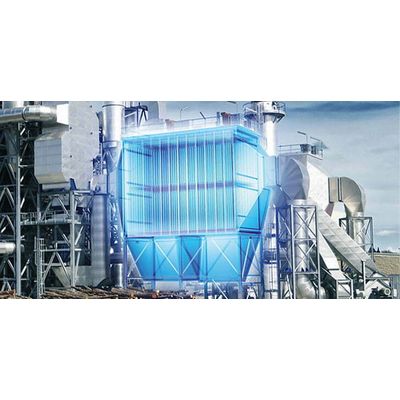
MDSJ - Ceramic Filter System
Ceramic Filter System includes the advantages of reverse bag air filters as well as Pulse Jet Bag Filters. Each chamber is similar to the Modular Pulse Jet Filter system. The cleaning process consists of isolating each compartment in turn and cleaning it with compressed air. Then all partitions are automatically cleared. Off-line cleaning is suitable for light and fine dusts and larger volumes where the formation of fluidization is a distinct possibility. The chambered Pulse-Jet filter contains 4 to 6 bag filter compartments.
Each compartment is similar to an on-line bag filter. If the bags are to be cleaned with air pulse (with pulse valve), gas flow from a compartment is temporarily stopped. Dust from the bags quickly settles in the bunkers due to the lack of gas movement in the bag filter chamber. During this time, the remaining chambers continue to filter gases as usual. Each compartment is cleaned in the same way, one after the other. Starting and stopping the gas flow from the separate compartments is provided by a compact pneumatic or manual damper system. Generally, the Chamber bag filter is used for larger gas volumes.
- 850ºC heat resistance,
- Spark resistant,
- Non-flammable,
- Self-supporting,
- Emission value 1mgr/m3,
- Highly chemical resistant
- Biochar waste incineration plants,
- Wood gasification,
- Glass melting furnaces,
- Ceramic kilns,
- Separation of radioactive material,
- Chemical industry applications,
- Melting furnaces,
- Coal-fired boilers.
Ceramic filter elements are cylindrical filters with high filtration capacity.
- Heavy carrier body construction,
- PulseJet cleaning system,
- High temperature dust discharge equipment
- Ceramic filter design
Ceramic filters are designed as single cells up to certain capacities. They are designed as chambered for larger volumes. Higher cleaning efficiency is achieved with lower pressure.
- They work safely at high temperatures.
- They are long-lasting and have excellent filtering properties.
- They show high resistance to chemicals. They work safely against gases containing sulfur and chlorine. They are also used for the absorption of some gases.
MSDJ Ceramic filter can work effectively at 850ºC. MSDJ filter elements have the best filtration results, the lowest emission value, low differential pressure and surface oriented.
Low-density ceramic filters, often referred to as “candles” because of their solid tube shape, have been used in pollution control to remove PM and acid gases since the late 1980s. It was additionally activated with (SCR) catalyst to reduce NOx. Test results for ceramic filters on glass were first reported by Gary Elliott and Andrew Startin. Test results were given for the pilot unit, and the authors concluded: “The use of low-density ceramic filter elements for pollution control and product recovery applications is now well established. The main benefits of ceramic elements are high filtration efficiency and high temperature capability, which are now allied with a catalyst capable of removing NOx. These benefits can be used most effectively to treat gases associated with glass furnaces.
Commented by David Gambier and Guy Tackles of Saint-Gobain: “Based on ceramic filters, the technology allows treatment of all contaminants in a single unit and at various temperatures from 260°C to 400°C. It is particularly suited to the needs of the glass industry and has already been installed at two European sites. Performance with particles in this temperature range cannot be matched by other technologies. As for the neutralization of acid gases, the ESP will be much lower.