


- Home
- Companies
- MDSJ Impianti
- Products
- MDSJ - Dilute Phase Pneumatic Conveying ...
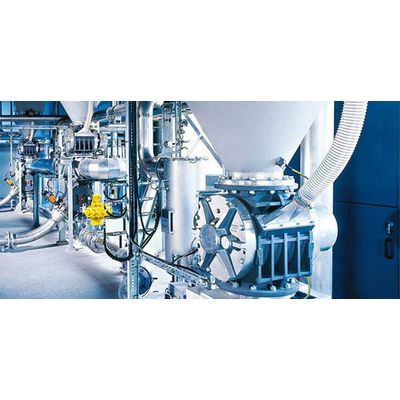
MDSJ - Dilute Phase Pneumatic Conveying Systems
MDSJ PROSES dilute phase pneumatic conveying systems use low air ratios and low pressures. In general, the air rate varies between 1-15 and 15-30m/s. Solid materials in powder and granular form are transported horizontally and vertically in suspension in the pipe. Sparse phase transport transfers products from one point to several points, or from several points to one or more points, positively and negatively. Its main components are vacuum pump, rotary or suction apparatus, filter system at the discharge point, transport pipes and automations with manual automatic options.
MDSJ PROSES has many years of experience in pneumatic conveying. You can call us for all your complex problems.
To send with pressurized dilute phase system, max. Fan or blower is used up to 1 bar pressure. Automatic cleaning Pulse jet filter is used for air product separation at the final destination. Positive displacement blower product feed in positive conveying systems consists of rotary, delivery pipes and filter equipment. The product is injected into the product pipeline as a package or as a continuous product. The product reaches its destination in suspension. MDSJ PROSES dilute phase transmission systems are installed with a capacity of 500kg up to 1ton hour capacity.
Fan or blower is used in the vacuum conveying system. In vacuum conveying, the pressure is generally up to 0.7 bar, and the air product ratio varies between 1-10. Material transfer can be done from one point to another or from several points to one or several points up to 50m distance and 150t/h capacity. Vacuum systems consist of a product feeding point, destination point, filter and vacuum pump at the final point.
- Minimum investment cost,
- Due to the low operating cost, it is appropriate to use non-abrasive materials as a result of transporting the dilute phase.
- Conveying materials that are highly abrasive, such as metal shavings and silica sand, can cause wear of the conveying line.
- The term dilution phase refers to a higher proportion of air and product mixture mixing during transport.
- It is determined by calculations derived from formulas that depend on pneumatic conveying factors. Distances (inclined and vertical), number of elbows, and total pipe lengths are used to determine the calculations.
Typical factors used for the calculation of pneumatic conveying systems are:
- Acceleration Factor
- Total horizontal and vertical distance in the system
- Total elbow det in the system
We are pleased to serve you, our esteemed customers, with MDSJ PROSES’s experience in pneumatic transport, in addition to the final calculated values of 30% to prevent the conveyor line from being blocked.
- Glass factories silica, feldspar, soda, coal and all raw materials,
- Thermal power plants ash coal,
- cement,
- Food
- Foundry factories,
- All kinds of under-filter dust transports
- wood