


SnifferDRONE - Methane Emissions Monitoring Drone
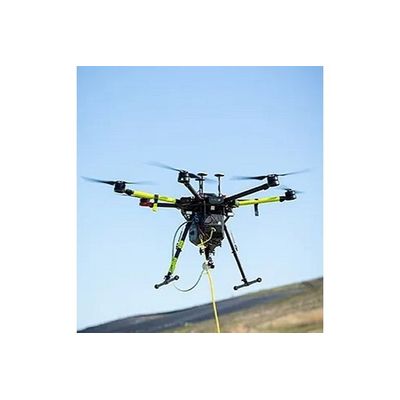
The patented* SnifferDRONE is an unmanned aerial system (UAS) useful for collecting land-based methane emissions data over large areas. The tool automates the method that is otherwise performed manually, providing a safer, more efficient, more effective, and comprehensive system solution.
The SnifferDRONE UAS consists of a package, designed and built by Sniffer Robotics, adapted to a commercially available unmanned aerial vehicle (UAV - drone). The system consists of:
- Methane detector.
- Flexible hose and weighted nozzle ("hozzle").
- Laser-guided system to enable terrain hugging capabilities
- Software for flight planning, flight control, in-flight reporting, algorithms for leak source detection and data management.
During flight, the UAS continuously collects air samples from the ground through the weighted nozzle, pumps the air samples to the onboard detector, measures the methane concentration, and reports leak source locations with GPS coordinates with 90% accuracy.
Data and leak source locations are pushed to a mobile app (Sniffer Field Ops™), allowing field technicians to quickly inspect the locations if required.
Methane emissions data collected by the SnifferDRONE are useful for a wide variety of purposes including US EPA compliance, emissions studies, and more.
- Contains an integrated emissions monitoring system with hardware and software specifically designed for the application.
- Detects methane concentrations in parts per million (1-100% ppm).
- Laser-guided "terrain hugging" and patented "hozzle" enables air samples to be collected at ground surface.
- Better process control of emissions monitoring through pre-programmed flight paths and objective data collection.
- Analytics of data, including temporal gas studies, emissions quantification (estimated gas flux), & operational KPIs.
- Versatile: useful for US EPA compliance and emission studies.
- >90% accurate at identifying leak sources.
- 50% faster than manual inspection for large terrestrial applications.