


- Home
- Companies
- MicroLAB Inc.
- Products
- MicroLab - Model 103 - Thermistor ...
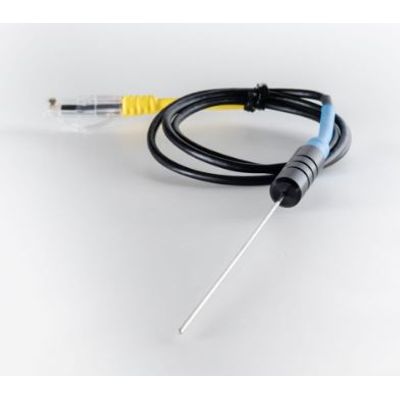
MicroLab - Model 103 -Thermistor Temperature Probe for Laboratory Use
The Model 103 Thermistor Temperature Probe by MicroLab is a robust and precise instrument designed for reliable temperature measurements within the typical laboratory range of -10°C to +110°C. Constructed from a durable 1/16-inch diameter stainless steel tube, and featuring a Delrin handle, this industrial-grade sensor is distinguished by its low thermal mass, enabling rapid responsiveness approximately three times faster than standard educational alternatives. Its electrical insulation from the shaft allows the thermistor to be deployed without interference alongside electrochemical sensors like pH, dissolved oxygen, or conductivity sensors. The device applies the negative temperature coefficient (NTC) and adheres to the Steinhart-Hart equation for its temperature response, providing high resolution and low noise measurements. Ideal applications include experiments related to phase changes, heat of reaction studies, and physical property investigations.
MicroLab’s thermistor-based temperature probe is an industrial grade temperature sensor mounted in a rugged 1/16-inch diameter stainless steel tube with a Delrin handle. Microlab’s thermistor probes are half the diameter and about 1/3 of the thermal mass of common educational alternatives. They respond about three times as fast – providing a much clearer view into temperature change experiments . MicroLab’s thermistor is electrically insulated from its shaft and can be used in the same solution with electrochemical sensors such as pH, dissolved oxygen, or conductance without interaction.
Features quick response, low thermal mass, high resolution, low noise, rugged “student-tolerant” design, long service life. MicroLab ‘s negative temperature coefficient (NTC) thermistor has an industrial temperature response described by the Steinhart-Hart equation.
This temperature probe is ideal for experiments involving:
- Change of state – melting pints, boiling points, supercooling.
- Physical properties – specific heat.
- Heat of reaction – endothermic or exothermic reactions.
- Gas laws, absolute zero
- Vapor pressure