


- Home
- Companies
- Wyatt Technology Corporation (WTC)
- Products
- miniDAWN - Multi-Angle Light Scattering ...
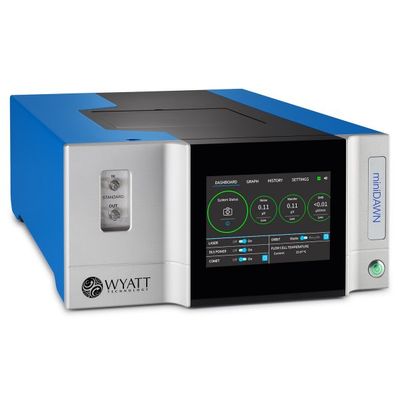
miniDAWN - Multi-Angle Light Scattering for Absolute Macromolecular Analysis
The miniDAWN determines absolute molar mass and size to characterize proteins, peptides, small polymers and nanoparticles in solution. Coupled to size exclusion chromatography (SEC or GPC), it eliminates the uncertainty and hassle of column calibration, for true confidence in macromolecular characterization.
Included with each miniDAWN is a copy of ASTRA, the most versatile software package available for analysis of online multi-angle and dynamic light scattering. ASTRA and the TREOS II incorporate advanced ease-of-use features that help guarantee excellent measurements with a single click.
Learn about the technical advances introduced in the TREOS II in the free white paper, The Next Generation Compact MALS Detector.
Molar mass, absolutely
Wyatt`s miniDAWN is most often used in conjunction with size exclusion chromatography (SEC-MALS) or field-flow fractionation (FFF-MALS) to determine distributions of molecular weight, size and composition. No need to make assumptions about molecular conformation or ideal column interactions.
Characterize:- Proteins, small peptides and oligonucleotides
- Synthetic and natural polymers
- Nanoparticles, virus-like particles and vesicles
- MW from 200 Da to 10 MDa
- rgfrom 10 to 50 nm, up to 150 nm with shape-specific models
- sensitivity down to 25 ng of 100 kDa polystyrene in THF, injected on a standard GPC column
The miniDAWN`s performance is exceeded only by the DAWN® which covers a wider range of size and molecular weight, with even better sensitivity and additional optional modules.
Ultrasonic Cleaning IncludedEach miniDAWN includes an embedded COMET™ ultrasonic transducer that cleans the flow cell automatically by agitating the fluid and loosening particles from the glass surfaces.
Modularity = ProductivityThe miniDAWN incorporates a fully modular design. Each module can be tested independently by the software to verify that it is functioning correctly. This imparts nearly complete field serviceability, since malfunctioning modules can be replaced and validated on-site by service engineers with no further calibration or alignment.
The miniDAWN is also field-upgradeable: the embedded WyattQELS™ DLS Module for measuring hydrodynamic radii from 0.5 to 50 nm can be installed on-site as well as in new units shipped from the factory.
Not just SEC-MALS...Wyatt`s miniDAWN may be used in batch (off-line) mode or in conjunction with a Calypso® CG-MALS system for characterization of average solution properties as well as macromolecular interaction properties including protein-protein binding affinity and complex stoichiometry.
With miniDAWN and ASTRA, SEC-MALS became a whole lot easier. Sample-specific methods are set up in three short steps with ASTRA`s Method Wizard, and new capabilities for automatic data processing mean that it takes just one click from your sample to a full report of the molecular weight and size results.
The miniDAWN`s System Ready monitor will even let you know when the system is fully equilibrated with low baseline noise, ready to run.
Dynamic Light Scattering
WyattQELS - A dynamic light scattering (DLS) detection module which integrates inside the miniDAWN chassis to provide simultaneous DLS measurements in the same scattering volume. The optical collection fiber is held in a dedicated 135° fiber mount.
DynaPro® NanoStar® - Primarily used for batch DLS, the NanoStar does double duty as an online DLS detector by installing its optical collection fiber into the miniDAWN.
Basic On-line Configuration
The miniDAWN may be positioned downstream of all types of standard GPC, HPLC or FPLC systems for analysis of molar mass and size distributions (see SEC-MALS page), and derivatives such as conformational analysis. For those systems equipped with a UV, RI, fluorescence or other type of concentration detector, the miniDAWN accepts 2 analog inputs so a 3rd-party concentration signal may be used in MALS calculations of molar mass. The miniDAWN instrument is generally set up downstream of a UV detector and upstream of a RI detector.
In most cases it is beneficial to connect an Optilab® as well as a UV detector. This permits universal concentration detection regardless of fluorophores or chromaphores. The combination of UV and RI signals is utilized in ASTRA`s Conjugation Analysis algorithm to characterize binary complexes such as glycoproteins, PEGylated proteins, membrane proteins enveloped in surfactant, or block co-polymers.
Advanced On-line Configurations
Wyatt`s miniDAWN may also be connected to an Eclipse™ Field-Flow Fractionation system for characterization of macromolecules and nanoparticles from 1 nm to > 100 nm via FFF-MALS.
Both SEC-MALS and FFF-MALS will benefit from an additional WyattQELS module for measuring nanoparticle size via dynamic light scattering. The WyattQELS utilizes the same laser and flow cell volume as MALS detection. Its collection fiber, placed at 135° to the laser beam, does not displace any of the three detectors in the miniDAWN.
For analysis of natural and synthetic polymers, a ViscoStar® online viscometer may also be added as well. Differential viscometry is an orthogonal means of determining molar mass and conformation.
MALS detectors may be operated in batch (unfractionated) mode when the analysis is targeted at:
Macromolecular interactions
- In order to characterize macromolecular or nanoparticle complexes which are disrupted by column shear or dilution
- In order to measure binding affinity or reaction kinetics of macromolecules such as protein-ligand interactions
Average solution properties
- If the sample is not amenable to separation by SEC or FFF, to measure weight-average molar mass, and size as z-average radius
- In order to validate SEC-MALS measurements:
- to determine if large aggregates or other species are filtered out on the column
- to determine if reversible aggregates dissociate subsequent to dilution on the column or FFF separation channel
Calypso - Automated sample preparation and delivery system for carrying out and analyzing composition-gradient MALS in a miniDAWN. Analyses include biomolecular interactions analyses high-concentration protein-protein interactions, Zimm plots and dn/dc as well as time-resolved MALS. Utilizes the CALYPSO software for interaction analysis.
Microbatch Kit - Used to inject samples into the flow cell of a MALS detector, and in determining dn/dc with an RI detector.
-
ASTRA - Our comprehensive software solution for MALS and DLS analysis in chromatography, AF4 or batch mode, included with each detector. ASTRA is available in a 21 CFR(11) compliant version and offers additional options such as particle analysis and a research database.
-
CALYPSO - Software for automated composition-gradient MALS experiments: control of the Calypso II, data acquisition and analysis for biomolecular interactions and reaction kinetics as well as weight-average molar mass, z-average molecular size, and virial coefficients.