


MirSense - Model QCL -Quantum Cascade Laser (QCL) Technology
The core technology underlying mirSense activity is the Quantum Cascade Laser (QCL). The QCL is a compact, lightweight and robust solid state laser source emitting in the mid-infrared. It is the result of state of the art scientific research on semiconductor quantum devices and years of academic and industrial developments since its invention, 25 years ago.
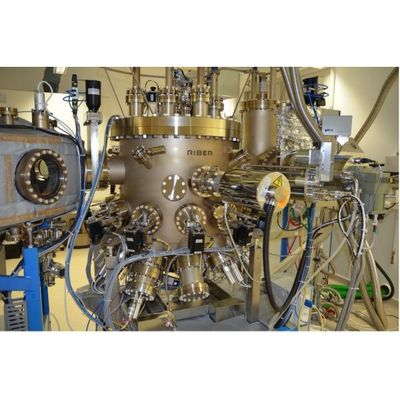
The QCL active region is based on a carefully quantum-engineered heterostructure, made of hundreds of nanometer-scale semiconductor layers, that allows to create a specific electronic density of states which leads to optical gain and lasing between cascaded electron subbands. The particularity of this concept is that the emitted wavelength does only depend on the layer thicknesses, not on the constituent materials. As a consequence, the same technology is capable of producing lasers in a very broad spectral range (λ from 3 to 20 µm). This is however a complex technology, that requires a very demanding control of all the fabrication steps, from the quantum design, to the multi-layer material growth, the device fabrication, the thermal management and the optical control of the emitted light.
The Design of the QCL structures – active region, waveguide and distributed feedback– is fully mastered at mirSense with proprietary modelling tools, thus ensuring a high agility and capability to respond to custom demands. We are the only QCL manufacturer to exploit two different semiconductor technologies: the standard InP-based technology and the alternative InAs-based technology. It allows to unprecedentedly extend the accessible wavelength coverage of QCLs down to 3 µm on one side and up to 20 µm on the other side.
The lasers work at room temperature with a built-in thermoelectric cooler for temperature control and stabilization. They can be operated in pulsed or continuous wave (CW) mode. The short pulse mode (typically 20 to 500 ns) is preferred for power QCLs, that can emit 1 to 2 W of average power at a typical duty-cycle of 50%. Single mode lasers rely on a patented distributed feedback (DFB) technology and exhibit typical output powers of 5 mW, well suited for infrared spectroscopy applications. They are tuned by changing the internal QCL temperature or driving current. In CW, the tuning range is typically 2 cm-1with a narrow linewidth (
The present maturity of QCLs offers unprecedented possibilities for defense applications or gas sensing through molecular spectroscopy applications that were previously limited by the lack of suitable laser sources.