

- Home
- Companies
- Control Instruments Corporation (CIC)
- Products
- Model 650 FID - High-Temperature Flame ...
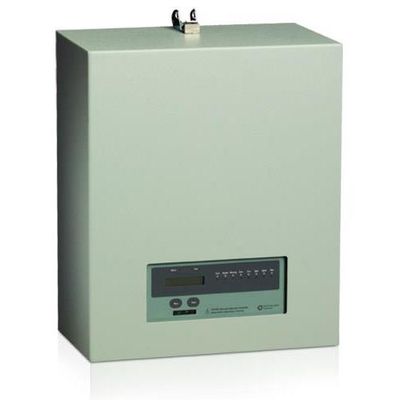
Model 650 FID -High-Temperature Flame Ionization Sensor
The Model 650 FID is a high-temperature flame ionization sensor that continuously measures total hydrocarbon concentrations. Industrial Design: Rugged industrial strength assembly suitable for continuous use in harsh environments. Direct Mount: Design eliminates heat-traced sample lines & allows the fastest response time. Fully Heated: To avoid condensation during sampling, the entire sensor pneumatic assembly is heated up to 200°C. Reliable: Integrated air-aspirated sampling system does not require pumps. Accurate:High linearity assures precise readings over the entire monitoring range.
Sensor Design
The Model 650 FID is a high-temperature flame ionization sensor that continuously measures total hydrocarbon concentrations. Control Instruments` proprietary FID design assures an accurate and linear response.
A carefully metered pilot flame incinerates the sample. The resulting ionized carbon passes through an electrical field, creating a proportional current flow. An electrometer measures the current flow. The resulting electrometer output is amplified and displayed as either: parts per million of a hydrocarbon (PPM); Milligrams of Carbon per Cubic Meter (mgC/m3); or PPM of Carbon by Volume (PPMCv).
Heated Sampling System
To avoid condensation during sampling, the entire analyzer pneumatic assembly is heated up to 200°C. This eliminates both inaccurate readings caused by solvent dropout as well as excessive maintenance time due to sample condensation and clogging.
The Model 650 is suitable for monitoring high flash point solvent vapors and other compounds with high temperature dew points. The sensor is unaffected by the temperature of the process and can sample streams at 1500°F (and higher).
The sensor can be mounted directly onto the process ductwork, as close as possible to the sample pickup point. This eliminates external heated sample lines and allows the fastest response time.
The sensor employs customer-supplied compressed air to drive its integrated air-aspirated sampling system. This method is simple, highly effective and requires very little maintenance. The sampling system does not require bottled air or sample pumps.
Failsafe Operation
A fault relay de-energizes whenever any of the following occur: sensor electrical failure; loss of system power; loss of heat; loss of vacuum in the flame cell; and downscale readings caused by loss of flame or fuel.
Outputs
The Model 650 has three (3) single-pole, double-throw relays for Warning, Danger, and Malfunction; and three (3) single-pole, single-throw relays for Horn, Calibration-in-Progress and Service Needed. Other outputs include a 4-20mA analog output and an RS-485 serial port with Modbus protocol.
Performance
Detector response time is 1.2 seconds. The sensor exhibits a very stable zero: less than one percent drift in thirty days. Span accuracy is less than five percent error per year.
The sensor is an industrial strength assembly suitable for continuous use in harsh environments; the optional NEMA 4X housing is suitable for direct mounting on the process indoors or out.
- Part Number: SNR650
- Calibration:
- PPM: Parts Per Million Hydrocarbon
- PPMCv: PPM Carbon by Volume
- mgC/m3: Milligrams carbon per cubic meter at 20°C
- Minimum Range: 0 to 33ppm as Propane (~100 PPMCv)
- Maximum Range: 0 to 20,000ppm as Propane (60,000ppmCv)
- Total Accuracy1:±3% full scale reading (cross calibration)
- Analyzer Accuracy2: ±1% full scale reading (single gas)
- Repeatability3: ±0.5% typical, ±1% maximum
- Resolution4:
- ±0.25% worst case, ±0.03% typical
- ±0.6% analog output
- Zero Stability: ± 1% in 30 days
- Span Stability: ± 5% in one year
- Linearity: Within 1% of full scale
- Cell Response Time: 1.2 seconds (T = 63.2%)
- Operating Temperature: Sensor pneumatics heated up to 200°C
- Power Requirement:
- 120 VAC+10%-15% 50/60 Hertz or
- 230 VAC +10% -15% 50 Hertz
- 200 Watts typical, 425 Watts maximum
- Fuel Requirements: 99.99% Hydrogen (Zero Gas, contains less than 1 ppm Hydrocarbon as methane)
- Fuel Consumption: 40cc per minute, 40-45 PSIG
- Compressed Air: 20 psig, regulated, instrument grade
- Air Consumption: 30 scfh, typical
- Humidity Range: 0% to 100% Relative Humidity
- Ambient Temperature: -40°C to 65°C
- Relays: 60 Watt contacts
- Relay functions: Six relays for: Warning; Danger; Fault; Horn, Calibration-in-Progress & Service needed.
- Alarm Function: Adjustable alarm ranges
- Analog Output: 4-20mA, 275 max. includes line length
- Digital Output: RS-485 Serial, Modbus protocol
- Flame Cell Material: Hard-coat aluminum
- Sample Train Material: Hard-coat aluminum & stainless steel
- Flame Cell Rating: Explosion Proof Class I, Division 1
- Hazardous Area Rating: General Purpose (Div 1 & Div 2 optional)
- Enclosure Rating: NEMA 12/13 Indoor (NEMA 4X corrosion-resistant, outdoor optional)
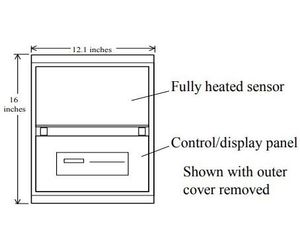
- Assembly Dimensions: 16.0" Hx12.1"Wx 8.5" D
- Weight: Approximately 18 Kg (40 lbs)
- Performance Criteria: Meets CFR 40 Part 60 Method 25A
- Total accuracy includes calibration gas, response factor and sample mix accuracies.
- Accuracy for a single gas, depends on accuracy of calibration gas & response factor.
- 0.5% near calibration point, 1% worst case over entire full scale.
- Based on digital signal processing and full scale of analyzer.