


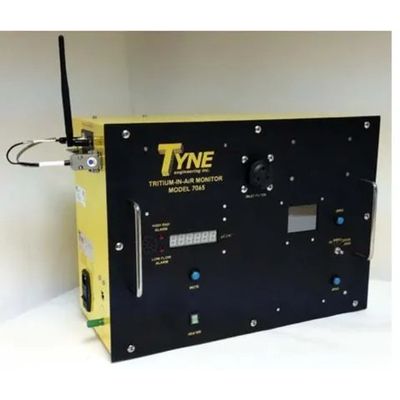
Model 7065 -Wall Mount Room Tritium In Air Monitor
Tyne Engineering`s Wall Mounted Room Tritium In Air Monitor: Model 7065 is intended for room monitoring for both tritium and gamma with the convenience of simple wall mounting for ease of removal for calibration or relocation. The 7065 instrument is based on the same platform used in Tyne’s successful Portable Tritium-In-Air Monitor: Model 7043.
The wall mount version employs four ion chambers that are approximately 3 times larger than those used in their Model 7043 hand held instrument, hence increasing sensitivity by a factor of 3. The wall mounted instrument also employs a larger and more powerful, low noise, and high reliability pump, which is easily accessible by removal of the front panel. This room tritium monitor also allows for easy removal of the wireless transmitter for independent tune-up of this unit.
- Simple to use, with only one operating switch with four settings: Off, Sample, Pump, Set Up.
- Gamma Compensation with four large ion chambers arranged in a symmetrical configuration. Two chambers are used for measuring the air sample and the other two for compensation.
- Better than 10% inaccuracy in 20 mR/hr field.
- High Sensitivity. The current amplification circuit employs ultra-low leakage technology. Each chamber has an
- individual amplifier, improving the Signal-Noise Ratio of the analog circuit.
- Radon compensation is provided by an analog filter circuit designed to separate the radon spike from the tritium signal. The unit’s software can distinguish the radon spike from the tritium signal occurring as a slow-change signal.
- Ion-traps are built into each ion chamber.
- Direct, wide range, gamma measurement is provided using an installed GM tube.
- Decontamination is easily performed by purging the ion chambers while simultaneously heating them using a centrally installed cartridge heater.
- Customer’s choice of hard-wired RS-232, Ethernet or an industry standard wireless connectivity.
- Self monitoring with low air flow alarm.
Compensation for gamma background is crucial in tritium measurement because a gamma field of 1mR/Hr will generate 500 times the ionization generated by l uCi/m3 of tritium. Tyne designed the four ion chambers in a symmetrical arrangement with each chamber connected to an ultra sensitive electrometer amplifier and filter. All signals pass through an ADC converter and a micro-processor calculates and displays the measured tritium values. The micro-processor also monitors air flow rate using a solid-state flow meter and controls the chamber temperatures during the heated purge cycle. A separate small ion chamber is used to cover higher tritium concentration ranges.
The front mounted LCD screen is a touch sensitive screen used to control device settings such as alarm levels. The instrument has both visual and audible alarm annunciation. The audible alarm can be canceled without canceling the visual annunciation. The touch screen panel is accessed by a two level password system. One password provides high level access allowing exclusive personnel to set up the device and the other provides restricted access enabling operators to only adjust certain features. The touch screen is augmented by use of a large digital read-out providing better, longer distance, visibility for operators.
The unit employs a front mounted high efficiency inlet air filter to ensure that the ion chambers do not become contaminated. If required, a sniffer probe adapter can be provided. The sniffer allows operators to locate suspected tritium leaks in the facility. For example, sniffing around a seal or flange to identify leaks.
Instrument output includes external communication via RS232, Ethernet and industry standard wireless to enable downloading or recording of information on a computer. The thin-film transistor (TFT) color LCD display mounted on the surface plate clearly displays instrument readings in both digital and graphic format showing real time measurements and trends.
The large ion chambers, configured in a compact internal module, enable a sensitivity that precludes the need for Methane or P-10 counting gases and the use of less reliable flow proportional counting systems. The ion chambers are robust and reliable, but if they become contaminated they can be purged by using an internally mounted heater while simultaneously pumping dry air through the chambers.
This wall mounted unit is powered by internal power supplies and only needs a standard 120 VAC three prong outlet to operate.