


- Home
- Companies
- Akfen Muhendislik & Engineering Co
- Products
- Model Akf 2000 Mini - Portable Crude ...
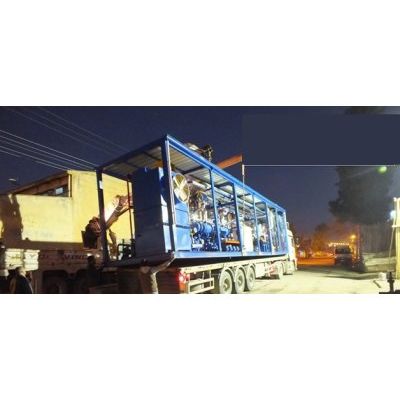
Model Akf 2000 Mini -Portable Crude Oil Refinery Plants
Portable Crude Oil Plant can be operated in the oil field to produce fuel for diesel engines. It is simple-to-operate, easy-to-start, and easy-to-shut down. Fill your diesel storage tanks and shut the plant down until it’s needed again. Akfen Mini-Refineries are skid mounted, modular crude oil distillation units (CDU) which process from 22.000 Liter of crude oil per Day and are capable of producing a variety of finished products including naphtha (straight run gasoline), kerosene, arctic and summer diesel and fuel oil. A reformer may be added for producing high-octane gasoline. Two or more plants can be installed on a single site allowing the simultaneous processing of more than one type of crude oil; and one plant can still be in operation in the event one plant is down.- Can be set up and in operation within two days after arrival at a site where the foundation and storage tanks are in place.
- A single operator may restart the plant from a cold start and have the plant in full operation in less than two hours.
- Are completely automated and once an operator sets all the controlling points, all product temperatures and flows are controlled automatically. If a product specification drifts off or if a potentially hazardous condition develops, the plant automatically adjusts itself to a safe condition, without the help of an operator and a “first out” annunciator signals the reason for the shutdown by a flashing red light. The operator can then make the necessary adjustment or the plant will automatically shut down.
- Only a flat support area or concrete slab without anchor bolts is required to support the plant.
- Requires no water, steam, or instrument air. Fuel supply can be off-gas, natural gas, naphtha, diesel fuel oil or a combination of these fuels.
Akfen Industries builds the following additional equipment for its Mini-Refineries:
- Special alloy(s) may be included in the plant design
- Desalter packages for removing salt from the crude
- Naphtha, jet fuel, and diesel hydrotreaters for removing sulphur from the products
- Reformers for producing high octane gasoline motor fuels
- Gasoline stabilizers for reducing the Reid vapor pressure of motor fuels
- Asphalt vacuum units for producing
- Winterized skids for operation in Arctic weather
- Portable laboratory and control buildings with supplies.
Mini-Refinery Applications
Traditionally, the petroleum industry has constructed large-scale refineries at centralized locations, supplying them with crude oil and gas condensate via pipeline and transport truck. Refined grades of products are subsequently transported from the refinery to consumer markets, primarily by transport truck.
While large-scale refineries provide the bulk of refined products to the world marketplace, the majority of new hydrocarbon discoveries by industry majors and large independents occur in areas where there is limited or no available infrastructure for transportation and refining. Therefore, producers are forced to construct expensive infrastructures for transporting the hydrocarbons to an available refinery, or construct a new refinery at a location near the production site. Under the best of circumstances this process can take several years.
In populated areas near a pipeline or oil field and not near a refinery, a small Akfen mini- refinery can be installed that will process crude from the pipeline.
This plant can "thief the diesel" or desired distillate for local consumption, and then injects the unused portion of the crude back into the pipeline.
REFINING EQUIPMENT
Akfen Industries and its associated engineering and manufacturing groups designs, manufactures and markets equipment capable of processing from 45.000 Liter of crude per day (BPD). Multiple product streams can be drawn from the distillation process yielding light naphtha, heavy naphtha, kerosene /jet fuel, diesel and residual fuel oil.
Each process plant is skid mounted, modular in design and transportable to the source of crude production or a pipeline location. System commissioning at the site, on the small units, can be complete within 48 hours after arrival at the completed site. These units are easily relocated
with a minimum amount of field construction. Refined products produced from a mini-refinery processing plant can be sold to local markets or supplied as a feedstock for further processing and the residual oil returned to the crude pipelines. Additionally, the residual oil product can be used to fuel diesel-electric cogeneration plants for the production of electricity or any heavy oil fired process equipment such as boilers, heaters and etc.
Mini-refineries are particularly effective in areas where there is a ready supply of crude but limited product distribution or refining capacity, where transportation costs or capability present a problem, such as remote areas or offshore platforms.
Typically, cold crude oil from off-site storage is received at the topping plant battery limits and pumped by the crude charge pump on flow control. The crude oil exchanges heat with the atmospheric tower product streams.
The crude then flows to the crude heater where it is further heated and partially vaporized. The crude heater is a direct-fired radiant-convection heater, designed to burn off gas, natural gas and/or liquid fuel, or a combination of these fuels. Constant heater outlet temperature is maintained automatically by controlling the fuel to the heater.
Partially vaporized crude oil from the crude heater flows to the flash zone of the atmospheric tower where the vapor and liquid separate. The vapor flows up the tower where it is cooled and partially condensed by reflux to form the side stream products. The liquid joins with the over flash liquid from the first tray above the flash zone and flows to the reduced crude stripping section in the bottom of the atmospheric tower.
The overhead vapor from the atmospheric tower is cooled and partially condensed in the overhead condenser and flows to the overhead accumulator where liquid unstabilized naphtha, water and uncondensed gas separate. The water is automatically withdrawn from a boot on the overhead accumulator and flows off-site.
A portion of the liquid naphtha from the accumulator is returned to the top of the atmospheric tower as reflux to maintain the overhead vapor at a constant temperature and the remainder flows to off-site storage. Uncondensed gas from the accumulator flows on backpressure control to be used as supple-mental fuel for the crude heater.
Un-stripped side draw product flows on tower temperature control from its draw tray on the atmospheric tower to its stripper. The side draw product is stripped with re-boiled vapor to control the flash point. Product flows from the bo ttom of the stripper on level control, is cooled by exchanging heat with crude, and then flows to battery limits.
Reduced crude product is pumped from the bottom of the atmospheric tower on level control through the re-boiler, and is then further cooled by the reduced crude/crude exchangers before flowing outbound to battery limits.
Since the side stream stripper is re-boiled with hot tower bottoms, the plant does not require steam. However, nozzles are provided on the tower and stripper for steam stripping, if required. The only requirement for water is for a desalter if one is included.