


- Home
- Companies
- Inventec B.V.
- Products
- Model DAS - Distributed Acoustic ...
Model DAS -Distributed Acoustic Sensing
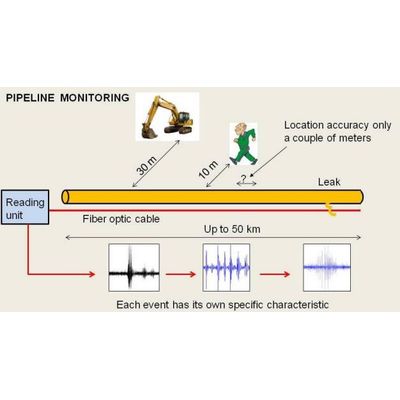
The system consists of an optical fiber that is connected to a reading unit. The fiber cable generally will be underground. The reading unit constantly launches a high frequency light pulse through the fiber and analyses the backscattered spectrum. Any activity (such as a walking person or moving car) up to a certain distance from the fiber or even a pipe leak produces acoustic energy that is absorbed by the molecules of the fiber material. This causes a phase shift in the backscattered spectrum that is analysed by the reading unit. The location of an event results from measuring the time that has lapsed between launching of the pulse and receipt of the backscattered light (Radar principle – the speed of light is constant). One single reading unit can detect an event with a couple of meters accuracy over distances up to 50km.
DAS does not only detect and locate an event but can even identify its nature. Acoustic energy can be generated by a wide range of events, from a leak in a pipe line to footsteps, vehicles, cutting of a cable, lifting a manhole cover or removing a cover from a cable duct. Each of these events has a unique acoustic footprint that is recognized by the reading unit. Thus the system does not only show where along the fiber an event takes place but it also identifies its nature. And thanks to the reading frequency of 200Hz it is even possible to see the direction in which the vehicle moves or the person walks. The uniqueness of the DAS-technology is that direct contact between fiber cable and source of the event is not required: as an example footsteps can be “heard” at 10m and vehicles at 30m distance from the fiber cable.
Contrary to what sometimes is thought, it is not the idea, nor is it necessary, that the fiber cable deforms or starts vibrating. The intended effect is caused solely by the fact that the silica molecules of the fiber material absorb the acoustic energy generated by the event as a result of which they attain a different energy state. This causes the phase shift in the backscattered light.
Pipelines: DAS provides a timely warning for third party activities such as digging and drilling operations. It is also ideal for leak detection of existing underground pipelines: the fiber cable does not need to be close to the pipe and an existing telecom fiber cable running parallel to the pipeline can be used in most cases. As DAS, such contrary to DTS, does not operate on the basis of temperature differences, it is the solution for leak detection when there is no or insufficient difference in temperature between the medium transported by the pipe and the surrounding environment.
Railways: Theft of copper wire poses a serious threat for safety. DAS surveys every meter of a railway. To avoid false alarms it distinguishes between regular maintenance operations and train passages on the one hand and events such as lifting a cover section of a cable duct, cutting a cable and unauthorized access on the other hand. Should there be a existing fiber cable running in the cable duct along the track then a fiber thereof can be taken to serve a DAS-system.
Perimeter security: Traditional systems such as CCTV or IR often do not provide optimal protection against undesired access to large perimeter areas. DAS monitors every meter of the perimeter 24 hours per day / 365 days a year on a real-time basis. The underground fiber cable is invisible and undetectable. The system identifies a large variety of activities such as footsteps, type of vehicle, climbing or cutting a fence and on top of that indicates the direction in which the activity is developing.
- Distance up to 50km
- Spatial resolution of only a couple of meters
- Easy installation and implementation
- Robust and maintenance-free
- Immune for electromagnetic induction
- Intrinsically safe, so suitable in hazardous areas
- Already existing fiber optic cables (e.g. telecom) can often be used.